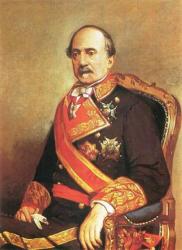
Friedrich Dollmann
 Germany
- Early Life and Education
- Military Career: Pre-World War II
- World War I
- Interwar Period
- World War II
- Operation Overlord and Death
- Notable Facts and Legacy
- Awards
- - Iron Cross 2nd Class (Kingdom of Prussia)
- - Service Cross 2nd Class (Kingdom of Bavaria)
Early Life and Education
Friedrich Dollmann was born in Würzburg, Germany in 1882 to Friedrich and Maria Dollmann. His father was a Bavarian military lawyer. At the age of 17, he joined the First Royal Bavarian Regiment of Field Artillery as a cadet. Subsequently, he attended the military academy in Munich (1900-1901), the weapons factory in Amberg (1903), and the school of engineering and artillery (1904).
Military Career: Pre-World War II
From 1905 to 1909, Dollmann served in a military regiment as an adjutant. In 1909, he entered the Bavarian Military Academy, graduating in 1912.
World War I
By 1913, Dollmann had become a captain and the commander of the 1st Artillery Brigade of his regiment. In early 1918, he joined the staff of the 6th Army, where he remained until the end of the war.
Interwar Period
After the war, Dollmann held various staff positions. He became a member of the Central Office of the Bavarian General Staff in 1919. In 1933, he was appointed Chief of Artillery of the Ministry of Defense. Two years later, he was promoted to commander of the 9th Military District.
World War II
With the outbreak of World War II in 1939, Dollmann took command of the 7th Army. In the Polish campaign, he covered Germany from the west. His son was killed during the battle. In the French campaign, the 7th Army entered Strasbourg and breached the French Maginot Line. Dollmann played a pivotal role in capturing 200,000 French troops near the Swiss border. For this feat, he was promoted to Colonel-General in July 1940.
Operation Overlord and Death
When the Allies launched the invasion of Normandy, Dollmann was in command of the 7th Army. In his absence, Erwin Rommel was in overall command of the German defenses. Dollmann led a series of counterattacks against the Allied landings but ultimately failed to prevent their breakthrough. He ordered the retreat from Cherbourg, which led to his downfall.
On June 28, 1944, Dollmann died under unknown circumstances. It is speculated that he either committed suicide or died of a heart attack. The command of the 7th Army was subsequently given to SS-Obersturmbannführer Paul Hausser.
Notable Facts and Legacy
- Dollmann was the only German general, apart from Erwin von Witzleben, who did not participate in the invasion of the Soviet Union.
- Though not a member of the Nazi Party, he was said to have been "virtually a Nazi."
- The capture of Alsace and Lorraine by Dollmann's 7th Army was a propaganda victory for the Nazis.
- Dollmann's health had deteriorated significantly by 1944 due to obesity and smoking.
- Hitler had intended to court-martial or dismiss Dollmann for the loss of Cherbourg, but Rommel and Gerd von Rundstedt intervened.
- Dollmann's death remains shrouded in suspicion, with some suggesting forced suicide.
- A memorial plaque in his honor can be found at the Church for Pilgrims on Bogenberg Mountain.
- Rommel's Chief of Staff, Hans Speidel, wrote that Hitler's methods "injured Dollmann deeply, both as a man and as a soldier."
Awards
- Jubilee Medal of Prince Regent Luitpold with Crown (Kingdom of Bavaria)
- Iron Cross 2nd Class (Kingdom of Prussia)
- Iron Cross 1st Class (Kingdom of Prussia)- Order of Military Merit 4th Class with Swords and Crown (Kingdom of Bavaria)
- Service Cross 2nd Class (Kingdom of Bavaria)
- Honor Cross of World War 1914/1918 with Swords- Wehrmacht Long Service Award
- Clasp to the Iron Cross 2nd and 1st Class
- Knight's Cross of the Iron Cross with Oak Leaves
- Knight's Cross (June 24, 1940)
- Oak Leaves (No. 518) (July 1, 1944)