
Gail Devers
 USA
USABiography of Gail Devers
Gail Devers, an American sprinter specializing in sprinting and hurdle running, was a runner from childhood. Her brother, Parenthesis (PD), used to run races with her and always teased her when she lost. One day, she decided that she no longer wanted to lose. Gail started training, and the next time they raced, she overtook her brother, and he never won again. From that moment on, running became the main purpose of her life. Gail found her path.

Early Life
Gail Devers was born on November 19, 1966, in Seattle, Washington. Her family later moved to National City, California, a small town near San Diego. While she was born in the northwest, she always considered Southern California as her home. Gail was a runner from childhood. Her brother, Parenthesis (PD), used to run races with her and always teased her when she lost. One day, she decided that she no longer wanted to lose. Gail started training, and the next time they raced, she overtook her brother, and he never won again. From that moment on, running became the main purpose of her life. Gail found her path.

Athletic Career
Gail excelled in running during high school, and all major universities wanted to recruit the talented athlete. She chose the University of California, Los Angeles (UCLA) and joined the university's track and field team. Her early accomplishments included the 100-meter dash and the 100-meter hurdles. In 1988, during her senior year, she set the American record in the 100-meter hurdles. And later, on July 23, 2000, she broke her own record. In addition to her success on the field and track, she also achieved academically, graduating from the university with a bachelor's degree in sociology.
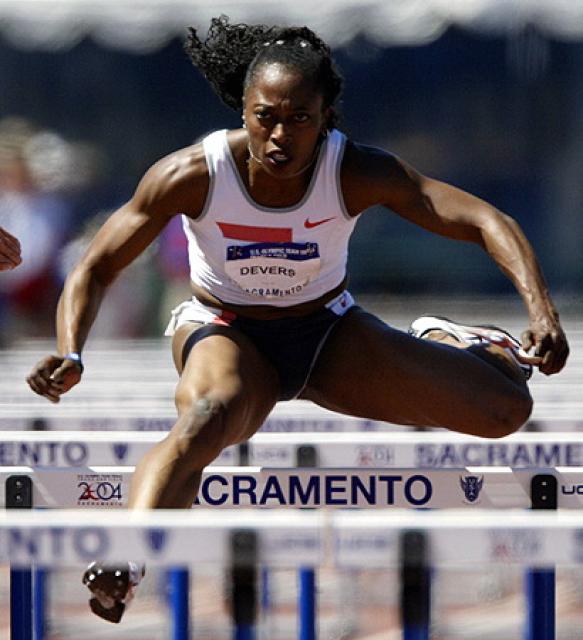
Despite her promising achievements, the young athlete faced one of the most challenging trials in her life in 1988. During her preparation for the Olympic Games in Seoul, her health began to deteriorate. Gail suffered from migraines, sleepiness, fainting spells, and periodic loss of vision. She needed to be at the peak of her performance, but instead, she was constantly exhausted and felt powerless over her body. Initially, she blamed her condition on the intense training before the Olympics. However, it was soon discovered that Gail had Graves' disease, a debilitating chronic disorder of the thyroid gland. By this time, her feet had swollen, covered in blisters, and her skin cracked and bled. The excruciating pain led her to stop training, and doctors believed that both of her legs would require amputation. Gail was devastated. Deep down, she was terrified that her life as an athlete was over. But she was determined not to give up; the word "quit" was never in her vocabulary. With immense effort, determination, perseverance, and faith in God, she managed to resume her training and regain her health. In 1992, less than 17 months after doctors considered amputating her legs, Gail won her first gold medal in the 100-meter hurdles at the Barcelona Olympic Games and was named the "fastest woman in the world." Throughout 1993, she continued her winning streak, earning seven championship titles. At the World Championships in Stuttgart, Gail achieved a feat that hadn't been accomplished in 45 years - winning both the 100-meter sprint and the 100-meter hurdles. Then, in 1995, after becoming the national and world champion, she claimed the top spot in the American rankings for the 100-meter hurdles. At the 1996 Games in Atlanta, she repeated her winning performance, earning a gold medal in the 100-meter dash, becoming the second woman to win two consecutive gold medals. She also won gold in the 4x100-meter relay. The 2000 Olympic Games in Sydney were predicted to be the pinnacle of her triumph. However, life once again presented an unexpected barrier. During her training for the Sydney Olympics, she experienced another setback. An injury to her Achilles tendon and left hamstring forced her out of the game for the next two months. After recovering, she won the 100-meter hurdles at the qualifying trials, breaking her own American record and posting the fastest time in eight years. However, in Sydney, injuries resurfaced, and Gail was forced to withdraw from the competition.

Overcoming Challenges
Whenever faced with difficulties, Gail always delved within herself and tapped into her spiritual and physical reserves. It provided her with the necessary focus, determination, and perseverance. Without such motivation, positive mindset, and belief, she would not have been able to achieve feats such as winning two gold medals at the 1996 Atlanta Games. Gail Devers is the founder of a sports foundation through which she now pays her athletic debt by assisting aspiring athletes. The athlete joyfully embraces the future, eager to share what she has learned during her long career, planning to write books and engage in active public work. "When I think about what I have achieved so far, I realize that I truly have been blessed. Now, I want to share my success by passing it on and helping others. That's when I will consider myself a true champion."




