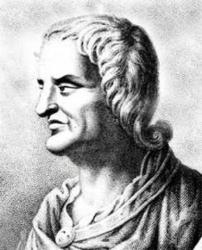
Geoffrey Chaucer
 Great Britain
Biography of Geoffrey Chaucer
Geoffrey Chaucer, the eminent English poet of the Middle Ages, is considered the greatest figure in English literature. He was known for his poems of love dreams and allegorical visions in the 14th century, which were a popular genre in France. The typical plot of these poems involved the arrival of spring, the poet's complaint about insomnia, falling asleep with a book, and dreaming of his own tale of love with allegorical images before waking up.
It is believed that Chaucer was born between 1340 and 1344 in London. His father, John Chaucer, was a successful wine merchant who held the position of assistant to the king's tailor in Southampton. The first record mentioning Geoffrey, dated 1357, was found in the expenditure book of Elizabeth, Countess of Ulster, the wife of Prince Lionel, one of the sons of Edward III. Geoffrey was mentioned as a page who was bought new clothing. It is likely that he attended school in London before becoming a page, as he was expected to know how to read, perform basic calculations, and have some knowledge of Latin and possibly French.
While in the service of Prince Lionel, Chaucer's education continued in a more aristocratic manner. He was expected to focus on the arts, further study French and Latin, and refine his skills in noble pursuits. In 1359-1360, Chaucer served in the English army in France during the intermittent Hundred Years' War, during which he was captured near present-day Reims. A significant ransom was paid for his release in early 1360, allowing him to return to England. In the same year, Chaucer traveled to France again, this time as a courier, while still in the service of Prince Lionel. This was his first of many diplomatic missions.
For the next seven years, there are no records of Chaucer's activities. It is highly likely that during this time he married Philippa Roet, who was in the retinue of the Countess of Ulster and later the queen. Philippa's sister, Katherine Swynford, became the most famous mistress and eventually the third wife of John of Gaunt, the fourth son of Edward III. In 1367, Chaucer's name reappears in documents, this time mentioned as a royal chamberlain who received a pension from the crown. From then on, Chaucer's name appears frequently in records, including royal gifts to him and his wife, new appointments, financial support, and diplomatic trips. An extremely important task assigned to Chaucer in 1372 was to negotiate with the Duke of Genoa. This appointment marked his first trip to Italy, which had a significant influence on his later works.
In 1374, Chaucer was granted a house in Aldgate and was appointed as an inspector of the customs of the Port of London. In 1375, he was granted supervision over the county of Kent, with various fines from the customs paid in his favor. From 1376 to 1381, Chaucer was allowed to appoint a deputy during his absences from London, indicating the importance of his position. Philippa continued to enjoy royal favor, and Chaucer most likely shared in her good fortune until her death around 1387.
However, there is evidence that even before Philippa's death, Chaucer found himself in dire financial circumstances. In 1386, he lost his house in Aldgate and both of his inspector positions. In 1387-1389, there are no records of subsidies paid to the poet, but there are several court orders for him to repay debts. In 1389, Chaucer was appointed as a supervisor of royal works, a position he held for two years. It is likely that Chaucer requested this resignation, as the job required constant travel, and he was getting older. There is no reason to believe he was dismissed for incompetence. Immediately after resigning, Chaucer received his last appointment as an assistant forester in the Royal Forest of North Petherton. Less is known about the subsequent years of Chaucer's life. Records of his salary payments are irregular, suggesting that he may have needed to borrow money from the Treasury. However, in 1399, he managed to lease a house near Westminster Abbey for 53 years. It was in this house that Geoffrey Chaucer died on October 25, 1400.
Chaucer's works are difficult to date accurately. His early works already showed promise, but they were also traditional and highly experimental, borrowing style and content from fashionable French writers at the English court. His poems of love dreams and allegorical visions were a favorite genre in 14th-century France. The usual plot involved the arrival of spring, the poet's complaint about insomnia, falling asleep with a book, and dreaming of his own tale of love with allegorical images before waking up. The Book of the Duchess, written in 1369, is considered Chaucer's first major poem. In this work, he carefully imitates French models, but his unique talent is already evident, despite his adherence to the traditional manner. The poem's clarity and freshness of decorative background, the realism of the hunting scene, combined with the abstraction of dream-like imagery, and the transition from stylized love dreams to heartfelt elegy, showcase Chaucer's skill.
Written approximately 10 years later, The House of Fame is a transitional work. In general, it follows the French tradition of love "visions," as it describes a dream and announces the intention to learn "love news" from the Houses of Fame and Rumor. However, The House of Fame, especially the second book, is more realistic in style. It features voices from Dante, medieval Latin poets and prose writers, and Chaucer's own lively style. The Parliament of Fowls, written in the early 1380s, follows the traditional French manner more closely than The House of Fame. However, the dream sequence, where birds gather on Valentine's Day to find their mates, is consistently realistic. Satirical political undertones can be found when the "noble" birds discuss their chosen partners according to courtly rules, while the bird suitors openly and crudely mock the gentlemen.
The unfinished Legend of Good Women is the last of Chaucer's "love visions" and somewhat foreshadows The Canterbury Tales. The visions are placed in the "Prologue," which is the best part of the poem. A May day, a garden, and the poet's charming prayer to a daisy set the stage. He falls asleep and dreams that the god and goddess of love appear to him, chastising him for writing about unfaithful women. To make amends, they command him to write about faithful ("good") women, and the prologue ends there. The main nine stories of the Legend are somewhat repetitive in theme and are mainly of interest today because they anticipate the structure of The Canterbury Tales.
Chaucer's poem Troilus and Criseyde was written before The Legend of Good Women but is a fully independent work that goes beyond the genre of love visions. The plot of the poem is largely borrowed from Boccaccio's Filostrato (or possibly a similar French text, The Romance of Troilus and Criseyde).
It is unknown when Chaucer conceived the composition of The Canterbury Tales. With his unique talent, Chaucer found a unifying plot - a pilgrimage to the tomb of St. Thomas Becket in Canterbury. The work presents all the characters of late Medieval society (except for the king and nobility - they would be out of place in such a journey).
In this work, Chaucer includes all the varieties of literature from the 14th century: chivalric and courtly romances, folk tales, fabliaux (stories with coarse humor), Breton lays, fables with animal characters, hagiographies, allegories, and sermons. Sometimes the poet includes previously written tales, while other times he adds new ones.
Chaucer's stanzas flow effortlessly in the London dialect of his time. His lines are diverse and rhythmical, showcasing his mastery of both rhythm and rhyme. In his early works, he occasionally used octosyllabic stanzas, but later adopted more flexible decasyllabic stanzas and the "rhyme royal" stanza.