Geoffrey de Havilland
 Great Britain
- Geoffrey de Havilland: British Aviation Pioneer
- Early Life and Education
- Aviation Career
- DH.9 and Post-War Production
- de Havilland Aircraft Company
- Aircraft Design and Innovations
- Notable Aircraft
- DH.88 Comet and DH.91 Albatross
- Personal and Legacy
Geoffrey de Havilland: British Aviation Pioneer
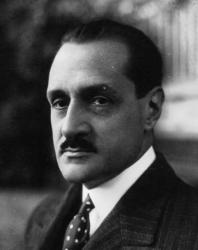
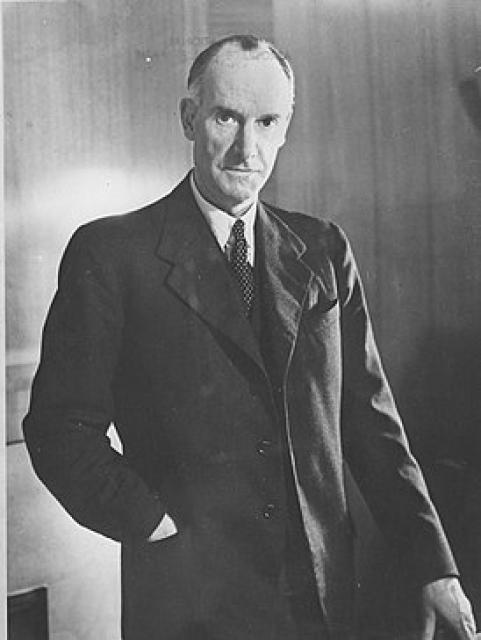
Geoffrey de Havilland was a British aviation pioneer, founder of the de Havilland Aircraft Company, and cousin to Oscar-winning actresses Olivia de Havilland and Joan Fontaine.
Early Life and Education
Born into an Anglican family in Buckinghamshire, de Havilland was educated at the Oxford University Preparatory School, Edward VII's College, Crystal Palace Engineering School. After graduating in 1903, he pursued automotive design before becoming interested in aviation following his marriage in 1909.
Aviation Career
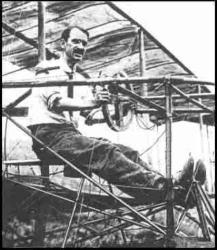
Early Experiments and AircoIn 1910, de Havilland constructed his first aircraft, which crashed on its maiden flight. Undeterred, he built a second plane, which he successfully flew and sold to his employer, the Royal Balloon Factory at Farnborough. This aircraft, designated F.E.1, became the first to bear the Royal Aircraft Factory roundel.
From 1911 to 1913, de Havilland worked independently at the Royal Balloon Factory. In January 1914, he joined the London-based aircraft manufacturer Airco as Chief Designer. Under his leadership, Airco produced various military aircraft bearing his initials: DH.1 through DH.9A. Of these, the Airco DH.4 and Airco DH.9 became the backbone of the Royal Air Force.
DH.9 and Post-War Production
Despite initial success, the DH.9 proved vulnerable in combat against German aircraft, resulting in high British losses. Nevertheless, production continued until 1920. The improved DН.9А, with more powerful American engines, became the primary fighter aircraft for the post-war RAF.
De Havilland's first twin-engined bomber, the Airco DH.10, took flight in 1918 and was produced in a series of 258 aircraft.
de Havilland Aircraft Company
Following World War I, Airco's assets were sold and the company shifted to automobile production. In 1920, de Havilland established his own enterprise, de Havilland Aircraft Company, at Stag Field in London. This company remained in operation until its merger with Hawker Siddeley in 1960.
Aircraft Design and Innovations
De Havilland's early aircraft designs drew heavily on his military experience, utilizing engines supplied by independent manufacturers. In the mid-1920s, he collaborated with Frank Halford to develop the Gypsy 120 hp engine. By 1927, de Havilland was producing his own line of Gypsy engines. In the 1930s, the company also produced a turbojet engine under the name de Havilland Goblin.
Notable Aircraft
DH.82 Tiger Moth and DH.84 DragonIn 1932, de Havilland introduced two highly successful aircraft: the DH.82 Tiger Moth, a single-engine biplane renowned for its handling and agility (8,686 units built), and the DH.84 Dragon, a versatile twin-engine transport (over 1,000 units built).
DH.88 Comet and DH.91 Albatross
The record-breaking DH.88 Comet won the MacArthur Robertson Air Race from England to Australia in 1934. While the Comet itself was a one-off design, it provided valuable experience in lightweight wooden construction that informed the later development of the de Havilland Mosquito.
In 1938-1939, the company produced a series of four-engined DH.91 Albatross aircraft for airliner use.
Personal and Legacy
Geoffrey de Havilland personally tested all types of aircraft produced by his company. In the mid-1930s, his son, Geoffrey de Havilland, Jr. (1910-1946), became the company's Chief Test Pilot. De Havilland's pioneering work in aviation left an enduring legacy, with his aircraft playing a significant role in military operations and commercial aviation.