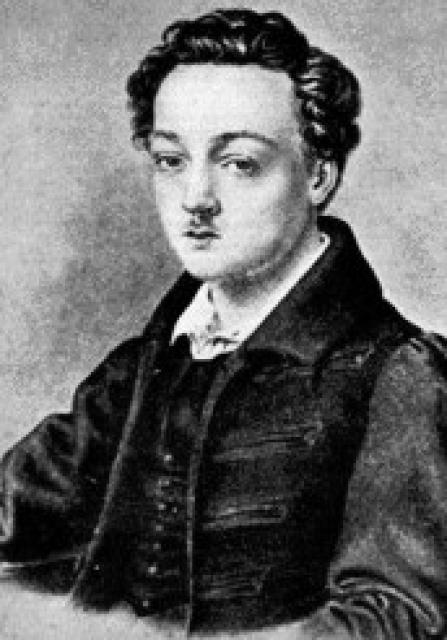
Georg Buhner
 Germany
- Georg Büchner: A Pioneer of German Realism
- Revolutionary Involvement and Political Persecution
- Academic Career and Literary Beginnings
- Groundbreaking Dramas
- Literary Legacy and Influence
- Tragic End
Georg Büchner: A Pioneer of German Realism
Early Life and StudiesGeorg Büchner, born on October 17th, 1813, near Darmstadt, left an indelible mark on German literature as a poet and playwright. He pursued a multifaceted education in medicine, history, and philosophy at the universities of Strasbourg and Giessen.
Revolutionary Involvement and Political Persecution
In 1834, Büchner's political activism in his native Hesse culminated in a revolutionary uprising. His authorship of a political pamphlet led to police persecution, forcing him to abandon his political pursuits in early 1836.
Academic Career and Literary Beginnings
Seeking refuge in Switzerland, Büchner resumed his education and delivered lectures on anatomy at the University of Zurich. During this period, he embarked on his literary career with the publication of three groundbreaking dramatic works: "Dantons Tod," "Woyzeck," and "Leonce und Lena."
Groundbreaking Dramas
"Dantons Tod" (1835), Büchner's renowned tragedy, delves into the life and death of the infamous French revolutionary, Georges Danton. The play's innovative structure, characterized by philosophical debates, introspection, and political rhetoric, pushed the boundaries of dramatic form.
"Woyzeck" (1837), Büchner's later masterpiece, chronicles the tragic life of a soldier based on a historical incident. This 27-scene drama examines the protagonist's vulnerability and psychological disintegration in the face of external oppression and emotional turmoil. Alban Berg's opera "Wozzeck" (1925) was an adaptation of Büchner's play.
Literary Legacy and Influence
Büchner's literary influence extended beyond his short lifetime. His writing, which exhibited a profound pessimism and realism, left a lasting impact on subsequent dramatists, including Frank Wedekind, Gerhart Hauptmann, and Bertolt Brecht.
Tragic End
In the midst of his literary pursuits, Büchner contracted typhus and succumbed to the illness on February 19th, 1837, at the age of 23. Despite his untimely death, his body of work remains a testament to his extraordinary talent and enduring legacy in German literature.