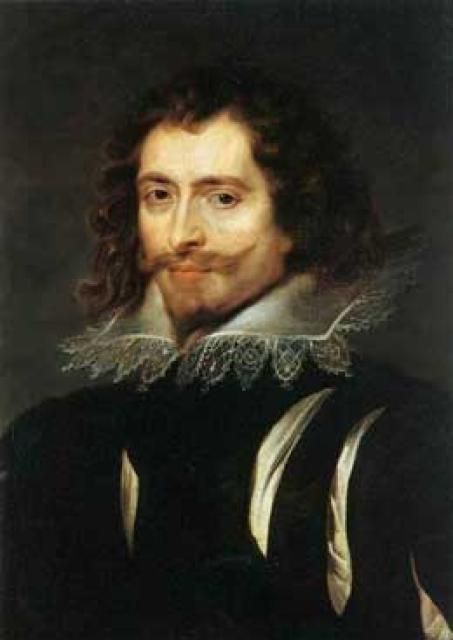
George Buckinghem
 Great Britain
- George Villiers, Duke of Buckingham: A Courtly Enigma
- A Meteoric Rise to Favor
- Political Intrigues
- Love and Scandal in France
- The Siege of La Rochelle
- Assassination and Legacy
George Villiers, Duke of Buckingham: A Courtly Enigma
Early Life and PatronageGeorge Villiers was born into a humble provincial family in 1592. After his father's death, his mother remarried twice, first to a sickly old man and then to Sir Thomas Compton, a wealthy but physically unprepossessing dwarf. Villiers' mother, Mery Bohun, relied on her beauty and charm to advance the fortunes of her sons, George and John. She introduced George to court, where his handsome features and charismatic personality caught the eye of King James I.
A Meteoric Rise to Favor
In 1616, Villiers was knighted and appointed a Gentleman of the Bedchamber with a salary of £1,000 per year. James I lavished him with titles and estates, elevating him to Viscount, Earl, Marquis, and eventually Duke of Buckingham in 1623. As the King's favorite, Villiers wielded immense power, eclipsing all rivals and even influencing the succession.
Political Intrigues
Buckingham's influence extended beyond courtly matters. He negotiated treaties, interfered in government affairs, and sold royal favors for bribes. He orchestrated the downfall of his political enemies, including Chancellor Francis Bacon. In 1625, he played a key role in arranging the marriage of Charles I to Princess Henrietta Maria of France.
Love and Scandal in France
Buckingham's diplomatic mission to France provided him with an opportunity to pursue a passionate and ill-fated love affair with Queen Anne of Austria. Their romance sparked a diplomatic crisis between England and France and inspired countless works of literature and legend.
The Siege of La Rochelle
In 1627, Buckingham commanded an English fleet in support of the Protestant Huguenots at La Rochelle, who were besieged by Cardinal Richelieu. Driven by his love for Anne, Buckingham hoped to use the conflict as a pretext to see her again. After a bloody and unsuccessful siege, Buckingham was forced to withdraw.
Assassination and Legacy
George Villiers, Duke of Buckingham, was assassinated on August 23, 1628, by John Felton, a disgruntled former naval officer. Buckingham's death marked the end of an era of courtly excess and a reminder of the dangers of hubris and unrequited love.
As a complex and controversial figure, Buckingham's legacy remains contested. He was both a skilled politician and a reckless libertine, a man of great wealth and influence but also a target of resentment and envy. His name continues to evoke the glamour and intrigue of the Stuart court.


