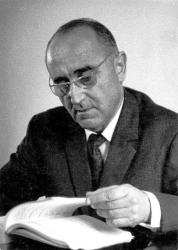
George Dantzig
 USA
USABiography of George Dantzig
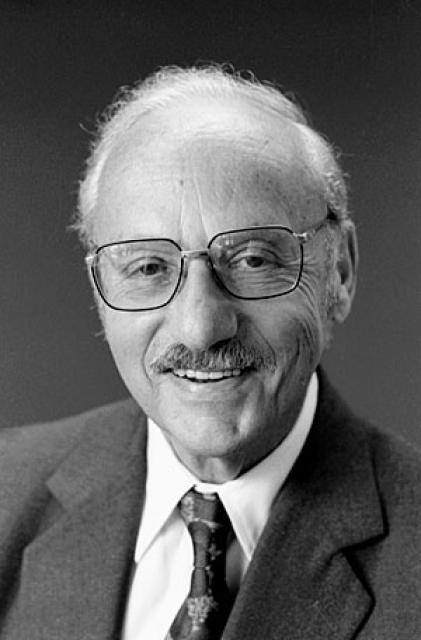
George Dantzig was an American mathematician who made significant contributions to the development of disciplines such as operations research, computer science, statistics, and economics. He was born on November 8, 1914, in Portland, Oregon, and was named after the writer George Bernard Shaw.
Dantzig's parents, Tobias Dantzig and Anja Dantzig, were both linguists, with his father being a mathematician and linguist of Baltic German descent, and his mother a French linguist. They met while studying at the Sorbonne, where Tobias studied mathematics under Henri Poincaré, one of the greatest mathematicians of all time, and it was in his honor that George was named. In 1910, they immigrated to the United States and settled first in Portland, then in Baltimore. In the early 1920s, the Dantzig family moved from Baltimore to Washington, D.C. George developed a fascination with geometry during his high school years, fueled by his father's efforts to find him particularly challenging problems, especially in projective geometry.
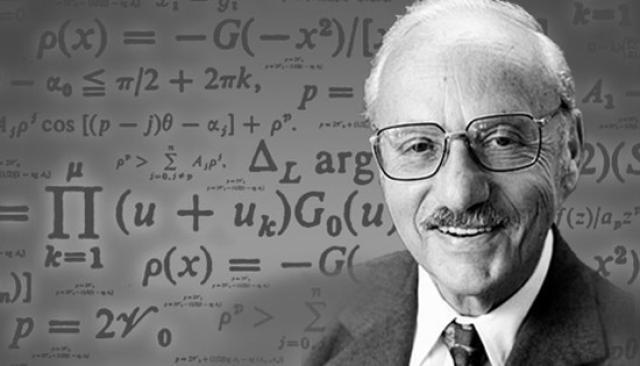
In 1936, George received a bachelor's degree in mathematics and physics from the University of Maryland, and in 1938, he earned a master's degree in mathematics from the University of Michigan. He then worked for two years at the Bureau of Labor Statistics before enrolling in a doctoral program in mathematics at the University of California, Berkeley. There, he studied statistics under the guidance of Jerzy Neyman.
In 1939, Dantzig arrived late to one of Neyman's lectures and saw two problems on the board. Thinking they were homework, he copied them down. The problems turned out to be "slightly more challenging than usual," but Dantzig managed to solve them within a few days and submitted the solutions to the professor. About a month and a half later, a flustered Professor Neyman approached him and explained that the "homework" given to the tardy graduate student were, in fact, the two most famous unsolved problems in statistical science. A year later, when Dantzig was contemplating his dissertation topic, Neyman shrugged and advised him to wrap up his solution to those problems, which became his doctoral dissertation. Years later, this story was used as an example of positive thinking and was portrayed in the film "Good Will Hunting."
During World War II, Dantzig briefly interrupted his doctoral program to join the Statistical Control of the United States Army Air Forces. In 1946, he returned to Berkeley and obtained his Ph.D. Although the university offered him a position to remain at Berkeley, he chose to serve as a mathematician consultant in the Air Force. In 1952, Dantzig joined the mathematical division of the RAND Corporation and, in 1960, became a professor of industrial engineering at Berkeley, where he founded and chaired the Operations Research Center. In 1966, he joined the faculty at Stanford University as a professor of operations research and computer science, and within a year, the operations research program became a full-fledged department. Dantzig continued his research and teaching at Stanford and beyond until his retirement in 1985. He was a member of the National Academy of Sciences, the National Academy of Engineering, the American Academy of Arts and Sciences, and received numerous national and international awards.
George Dantzig passed away on May 13, 2005, at his home in Stanford, California, at the age of 90, due to complications from diabetes and cardiovascular diseases.