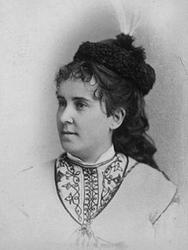
Georgia Ann Laster
 USA
Georgia Ann Laster was an American soprano whose career carried her from church and school choirs in Little Rock to major concert halls in the United States and Europe. A protégée of Marian Anderson, she earned recognition for her clear, expressive voice and musicianship, and became one of the prominent Black classical singers of her generation.
Early Life and Training
Laster was born in Little Rock, Arkansas, on November 18, 1927. She began singing in church as a child and often performed as a soloist with her high school’s a cappella choir. After completing her early education in Little Rock, she moved to Los Angeles to study music at the University of Southern California. She graduated from USC’s School of Music in 1948 and also pursued private vocal study with Nadina de Sanctis.
Her talent attracted notice while she was still establishing herself. In 1948, she won an Atwater Kent Foundation audition, and the following year she received a scholarship from the National Association of Negro Musicians. Further honors included the University of California Young Artists Foundation Award, the Marian Anderson Award, the John Hay Whitney Award and a Lotte Lehmann scholarship. She also received a Fulbright scholarship for study in Europe.
Concert Career
Laster’s breakthrough came with the 1953 Walter W. Naumburg Foundation vocal competition, where she won first prize. The award led to her New York debut at Town Hall on December 1 of that year. She appeared at the Hollywood Bowl, Redlands Bowl and Pasadena Playhouse, and performed with orchestras including the Portland Symphony, San Diego Symphony and San Francisco Symphony. At the San Francisco Symphony, she sang under conductor Bruno Walter; at the San Diego Symphony, she appeared with Robert Shaw conducting.
Her touring career took her across the United States and to Japan, the Caribbean, South America and Europe. Reviews from European audiences praised her performances in cities including Stockholm, Berlin, Oslo, Vienna and Copenhagen. In a 1955 review of a New York recital, *The New York Times* noted her “sensitivity and musicianship” alongside the natural beauty of her voice. Her repertoire ranged from European art songs to English-language works and spirituals, connecting classical recital traditions with music rooted in the African American experience.
Teaching and Legacy
Alongside performing, Laster shared her knowledge as a teacher. She taught voice in Los Angeles schools and joined the music department at Brooklyn College in 1960. Her career was cut short on September 4, 1961, when she died in a car accident near Lodi, California. Her mother, Georgia E. Laster, also died in the crash.
Laster’s legacy continued through the Georgia Laster Association of Musicians, a Los Angeles branch of the National Association of Negro Musicians named in her honor. The organization’s name recognizes a singer whose accomplishments helped expand the visibility of Black classical musicians and who inspired younger generations through both her performances and her teaching.