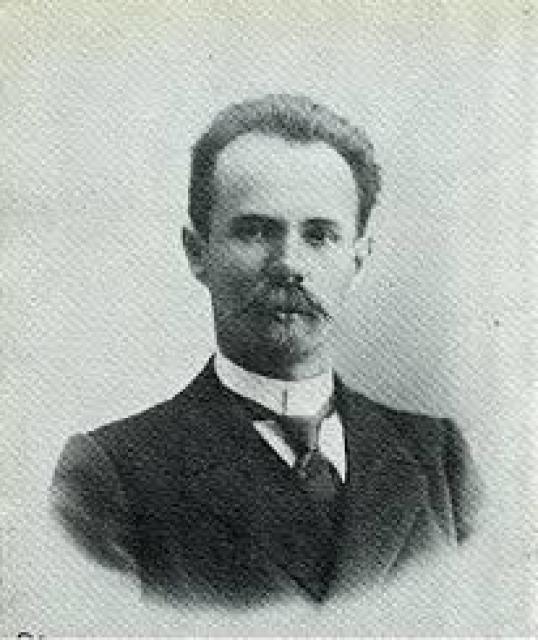
Georgy Konyus
- Early Life and Education
- Teaching Career
- Return to Moscow and Later Career
- Compositions
- Theoretical Writings
- Legacy
Early Life and Education
Georgy Eduardovich Konyus was born into a musical family in Moscow, Russia, on February 13, 1862. His father, Édouard Konyus, was a French pianist and composer, while his mother, Nadezhda, was a Russian pianist and music teacher. Georgy was the eldest of three brothers; his younger brothers, Lev and Julius, also became composers.
Konyus began studying music at an early age, taking piano lessons from Nikolai Zverev and later from Alexander Skryabin. In 1889, he graduated from the Moscow Conservatory as a composer, having studied with Anton Arensky, Sergei Taneyev, and Paul Pabst.
Teaching Career
After graduating from the conservatory, Konyus began his teaching career at the Moscow Conservatory, where he taught harmony and instrumentation from 1891 to 1899. In 1904, he became the director of the musical-dramatic school of the Moscow Philharmonic Society, a position he held until 1906.
From 1912 to 1919, Konyus taught at the Saratov Conservatory, where he served as professor from 1918 and director from 1917 to 1919. In 1920, he became the head of the section for special musical education at the Main Committee for Professional Education (Glaprofobr).
Return to Moscow and Later Career
In 1920, Konyus returned to the Moscow Conservatory as a professor of musical form. He also served as dean of the Conservatory's composition faculty from 1922 to 1929. From 1921 to 1931, he led the Laboratory for Metro-Tectonic Analysis at the State Institute of Musical Science (GIMN).
Konyus was awarded the title of Honored Artist of the RSFSR in 1927. He continued to teach at the Moscow Conservatory until his death in Moscow on June 2, 1933.
Compositions
As a composer, Konyus wrote a variety of works, including orchestral, choral, and chamber music. His best-known works include the suite "From Childhood's Life," the cantata "In Memory of Emperor Alexander III," and the symphonic poem "From the World of Illusions."
Theoretical Writings
Konyus was also a prolific writer on music theory. His most important works in this field include "Textbook of Practical Study of Harmony" (1894), "Collection of Exercises in Elementary Music Theory" (1902), and "Metrotectonic Method for Investigating the Form of Musical Organisms" (1933).
Legacy
Georgy Konyus was a prominent figure in Russian music during the late 19th and early 20th centuries. His contributions to music theory and education continue to be influential, and his compositions remain popular among performers and audiences alike. Among his notable students were Sergei Rachmaninoff, Alexander Goldenweiser, and Paul Hindemith.


