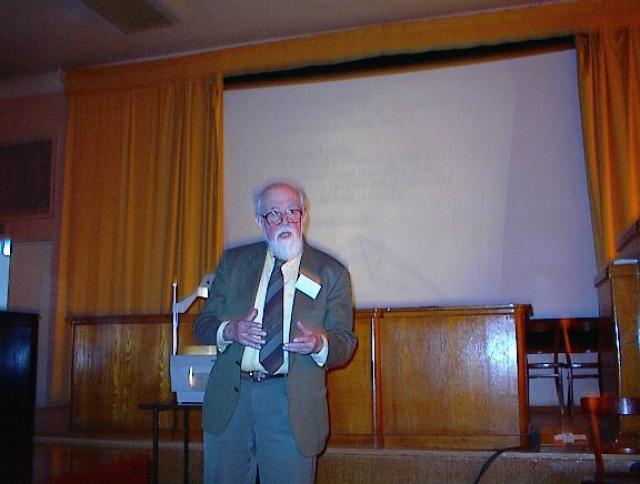
Gerard Laman
 Netherlands
Early Life and Education
Born in the Netherlands, Gerard Laman completed his secondary education at the Leiden Gymnasium in 1942. During World War II, he concealed himself to avoid forced labor by the occupying German forces.
Laman went on to study mathematics and mechanics at Leiden University, earning his degree in 1952. He served as a research assistant to Professor Johannes Hantjes from 1949.
Academic Career
In 1953, Laman received a scholarship to study combinatorial topology in Brussels under Professor Guy Hirsch. Upon his return, he worked as a mathematics teacher at a secondary school in Delft from 1954 to 1957.
Under the supervision of Professor Willem Titus van Est, Laman completed his PhD thesis at Leiden University in 1959. From 1957 to 1967, he was a lecturer at the Technische Hogeschool in Eindhoven (now Eindhoven University of Technology).
In 1967, Laman joined the faculty of the Mathematical Institute of the University of Amsterdam, where he taught mathematics and discrete mathematics to econometrics students. He considered himself primarily an educator, valuing his ability to organize his thoughts concisely in both speech and writing.
Research and Legacy
Laman is best known for his groundbreaking work on Laman graphs (1970). This concept in graph theory proved pivotal in understanding minimal rigid frameworks composed of hinged rods on a plane.
Despite Laman's initial publication going largely unnoticed, his ideas gained recognition after Professors Branko Grünbaum and Geoffrey Colin Shephard featured his work in their "Lectures on Lost Mathematics" (1978).
Throughout his career, Laman pursued advancements to the concept of Laman graphs for analyzing non-rigid rod structures in both the plane and in space. This area of research remains a topic of active study (see Graver, Servatius & Servatius, 1993).


