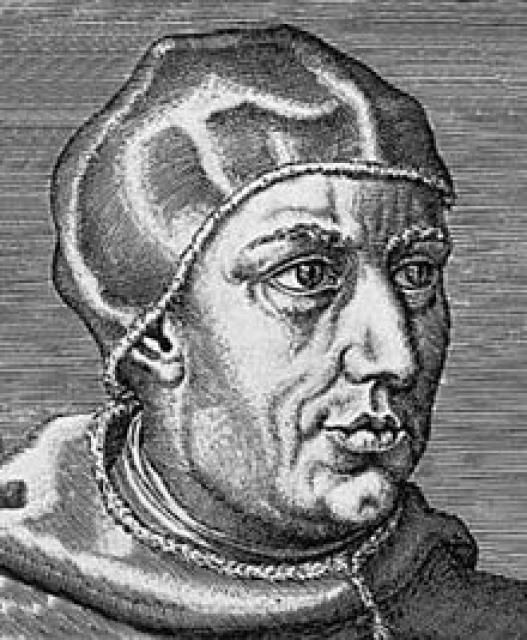
Mihael Shtifel
 Germany
- Biography of Michael Stifel
- Early Life and Involvement in the Reformation
- Numerological Studies and Controversial Predictions
- Contributions to Mathematics
- Later Years and Legacy
Biography of Michael Stifel
IntroductionMichael Stifel was a German mathematician and one of the inventors of logarithms. He was also an active figure in the Protestant Reformation.
Early Life and Involvement in the Reformation
Stifel was born in 1487 in Esslingen, Germany. He initially pursued a career in the church and became a monk in the Order of Saint Augustine. However, his interests soon turned to mathematics and he began studying the subject extensively.
The Protestant Reformation began soon after, and Stifel aligned himself with Martin Luther's teachings. His poem, Von der christfermigen rechtgegründeten leer Doctoris Martini Lutheri (1522), caused a scandal, leading Stifel to flee to Frankfurt. Luther helped him secure a position as a pastor.
Numerological Studies and Controversial Predictions
During his time as a pastor, Stifel delved into numerological studies of the Bible, attempting to uncover hidden numerical meanings within it. In his book "On the End of the World," he claimed that the name of the recently deceased Pope Leo X (LEO DECIMVS) corresponded to the Number of the Beast, thus predicting that the end of the world would occur on October 19, 1533, at 8 o'clock in the morning.
When his prediction did not come true, Stifel was arrested and imprisoned for four weeks. After this experience, he refrained from making further predictions.
Contributions to Mathematics
From 1535 to 1547, Stifel served as a Protestant pastor in Holzdorf. It was during this period that he made his major contributions to mathematics. In his main work, "Arithmetica integra" (Nuremberg, 1544), he presented a comprehensive theory of negative numbers, exponentiation, various progressions, and other sequences. Stifel introduced the concepts of "root" and "exponent" (Latin: exponens), analyzing both whole and fractional exponents.
He also published a rule for generating binomial coefficients and compiled tables up to the 18th degree. Stifel extensively revised the book of algebraist Christoph Rudolff, essentially rewriting it. The modern symbols for arithmetic operations used in mathematics today were established from this point on (1553).
In the same book, Stifel expressed the idea that later formed the basis of logarithm theory. He proposed comparing geometric and arithmetic progressions, which allowed the labor-intensive process of multiplication to be replaced by simple addition. However, Stifel did not publish any computational tables to implement his idea, and the credit for the invention of logarithms went to John Napier.
Later Years and Legacy
Following the outbreak of the Schmalkaldic War, Stifel was forced to flee again, this time to Königsberg. In 1559, he moved to Jena, where he became the first professor of mathematics at the city's university.
Stifel's scientific work left a significant impact on the development of algebra. Although he did not achieve recognition as the inventor of logarithms, his contributions to mathematics and his role in the Protestant Reformation solidify his place in history as a notable figure.


