Gerasim Pavskij
 Russia
- Archpriest Gerasim Petrovich Pavsky (1787-1863)
- Academic Career and Hebrew Studies
- Hebrew-Russian Dictionary:An unpublished comprehensive dictionary.
- Bible Translation and Editorial Roles
- Religious Studies at Saint Petersburg University
- Contributions to "Christian Reading" and Other Journals
- Religious Educator and Teacher to the Imperial Family
- Allegations of Heresy and Dismissal from Court
- Return to Academia and Philological Contributions
- Dispute with the Symbolists
- Enlightenment in Religious Education and Controversy
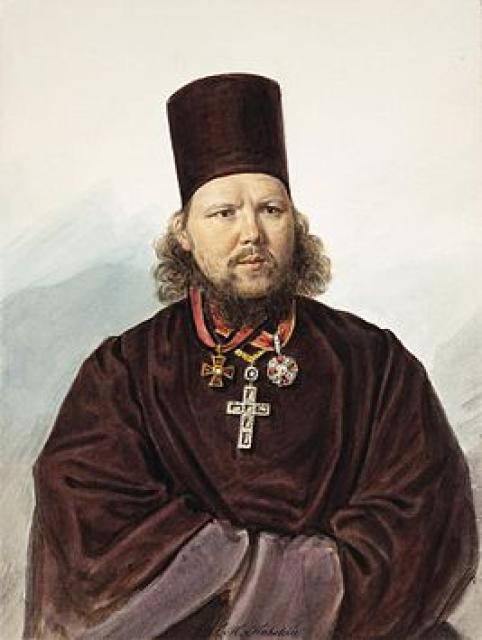
Archpriest Gerasim Petrovich Pavsky (1787-1863)
Early Life and EducationGerasim Petrovich Pavsky was born in 1787 as the son of a priest in the Luzhsky district. He received his early education at the Alexander Nevsky Seminary and subsequently pursued his studies at the Saint Petersburg Theological Academy, where he graduated first in his class in 1814 and earned the distinction of being the first magistre (Doctor of Divinity).
Academic Career and Hebrew Studies
In the same year of his graduation, Pavsky was appointed to the Chair of Hebrew Language at the Saint Petersburg Theological Academy, a position he held until 1835. His notable contributions to Hebrew scholarship include:
Grammar and Anthology of Hebrew Language:Pioneering works that served as essential textbooks for Hebrew studies in Russia.
Hebrew-Russian Dictionary:An unpublished comprehensive dictionary.
Magisterial Dissertation on the Book of Psalms:Pavsky presented a groundbreaking theory, now widely accepted, that the Psalms were composed by various authors over a significant period, not solely by David.
Bible Translation and Editorial Roles
Pavsky joined the Russian Bible Society in 1814 and served as its director. From 1820 onwards, he assumed responsibility as editor for the Society's Old Testament translations, including the historical books up to the First Book of Kings. Pavsky also translated the Gospel of Matthew into Russian. Additionally, he oversaw the editorial process of all New Testament translations published by the Society.
Religious Studies at Saint Petersburg University
In 1819, Pavsky was appointed to the Chair of Theology at Saint Petersburg University. His lectures, according to Nikita Tenishev, exhibited "something completely unique and characteristic, a gravitas and almost childlike innocence, strength, and simplicity combined with profound insights and an astonishing wealth of knowledge."
Contributions to "Christian Reading" and Other Journals
Pavsky became a key contributor to the influential journal "Christian Reading" from 1821 onwards. He authored original articles, translated extensively from the works of the Church Fathers, and edited other translations printed in the journal until 1839. He also published in journals such as "Library for Reading," "Annals of the Faculties," and "Proceedings of the Second Branch of the Academy of Sciences."
Religious Educator and Teacher to the Imperial Family
In 1826, Pavsky was appointed as religious tutor to the heir to the throne, Grand Duke Alexander Nikolaevich, and the Grand Duchesses. He prepared a comprehensive plan for the upcoming lessons, a foundational document for religious education in Russia and the first of its kind. Subsequently, he authored two textbooks for religious instruction: "Christian Doctrine in a Brief System" and "Outline of Church History."
Allegations of Heresy and Dismissal from Court
In 1841, Pavsky's "Christian Doctrine in a Brief System" and "Outline of Church History" attracted controversy, prompting allegations of heterodoxy from Metropolitan Filaret of Moscow. After a review process in which Pavsky successfully defended his beliefs, Emperor Nicholas I initially dismissed the complaints. However, upon further pressure from the aging Bishop Seraphim of Saint Petersburg, Pavsky was dismissed from his position as religious tutor.
Return to Academia and Philological Contributions
Following his dismissal, Pavsky dedicated himself to scholarly pursuits. His seminal work, "Philological Observations on the Composition of the Russian Language," published in three volumes in 1841-42, earned him the Demidov Prize from the Academy of Sciences in 1844. In this work, he demonstrated his extensive knowledge of languages, including Semitic, Slavic, Sanskrit, and Old High German. Pavsky's contributions to Russian philology were highly praised by renowned scholars such as Belinsky and Alexander Vostokov.
Dispute with the Symbolists
In 1880, an extensive manuscript by Pavsky, "Materials for Explaining Russian Root Words through Foreign Words," was discovered. The work attempted to provide an etymological dictionary of the Russian language. However, due to the shortcomings of his etymological methods, the work has not been deemed of significant scholarly value.
Enlightenment in Religious Education and Controversy
Pavsky's approach to religious education emphasized enlightenment and reason. However, his 1841 translation of the Old Testament, widely disseminated through student notes, drew accusations of heterodoxy. Despite clearing himself of such accusations, his translation was criticized by the Holy Synod. Nonetheless, under Emperor Alexander II, he was reinstated to the clergy and granted a pension.