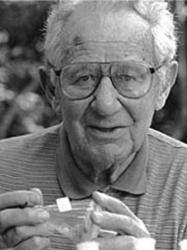
Gerbert Braun
 Great Britain
- Herbert Charles Brown: A Pioneer in Organic Chemistry
- Research and Academic Career
- Nobel Prize-Winning Work
- Innovations in Organic Synthesis
- Impact and Legacy
- Personal Life
Herbert Charles Brown: A Pioneer in Organic Chemistry
Early Life and EducationHerbert Charles Brown, an American organic chemist, was born on May 22, 1912, in London, England, to Pearl (Gorenstein) and Charles Bovarnik. His parents were Ukrainian Jewish immigrants who settled in London in 1908 and later relocated to Chicago in 1914. Brown's father anglicized their surname to "Brown."
Brown attended Haven School and Englewood High School in Chicago. Despite losing his father to illness in 1926, Brown excelled academically while helping with the family's hardware store. He received a partial scholarship to attend the University of Chicago, graduating with a Bachelor of Science degree in 1936.
Research and Academic Career
Under the mentorship of renowned chemists Maurice Karasch and Julius Stieglitz, Brown pursued his doctoral studies at the University of Chicago. His dissertation focused on the chemical reactions of diborane, a rare and expensive compound at the time. He discovered that diborane was a versatile reducing agent, capable of selectively reducing carbonyl compounds to alcohols under mild conditions.
After graduating in 1938, Brown worked briefly with Karasch and Schlessinger, who had guided his doctoral research. In 1943, he joined the faculty of Wayne University (later Wayne State University), where he rose to the rank of associate professor.
In 1947, Brown was appointed a full professor of chemistry at Purdue University. He remained there until his retirement. In 1959, he received the title of distinguished professor, and in 1978, he became an emeritus professor.
Nobel Prize-Winning Work
Brown's groundbreaking contributions to organic chemistry earned him widespread recognition. In 1955, he discovered a reaction known as hydroboration, which involves the addition of diborane to carbon-carbon double bonds to form organoboranes. These organoboranes can undergo further reactions, providing new and efficient routes for organic synthesis.
Innovations in Organic Synthesis
Building on his discovery of hydroboration, Brown developed a range of organoboranes and metal hydrides. These compounds became powerful reducing agents, expanding the synthetic toolkit available to organic chemists.
Brown's work also advanced the understanding of physical organic chemistry, particularly the relationship between molecular structure and reactivity. He investigated the steric effects in organic reactions, paving the way for more precise predictions of reaction outcomes.
Impact and Legacy
Herbert Charles Brown's innovative techniques in organic chemistry revolutionized the field. His discovery of diborane as a reducing agent and his development of hydroboration opened up new possibilities for the synthesis of complex organic molecules.
Brown's work has had far-reaching applications in various industries, including pharmaceuticals, materials science, and agriculture. His groundbreaking contributions earned him numerous awards and accolades, including the Nobel Prize in Chemistry in 1979.
Personal Life
Brown married Sarah Baylen in 1937, a fellow graduate student from the University of Chicago. They had a son, Charles, who also became a chemist. Brown was a charismatic and energetic researcher, mentoring countless young scientists and regularly publishing his findings.
Herbert Charles Brown died on December 19, 2004, in Lafayette, Indiana. He left behind a legacy as a brilliant chemist who transformed organic synthesis and inspired generations of scientists.