Gerbert Kremer
 Germany
Biography of Herbert Krömer
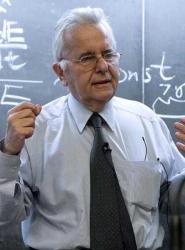
Herbert Krömer, born on August 25, 1928, in Weimar, Germany, is a German physicist and Nobel laureate in Physics. He was awarded half of the Nobel Prize in 2000, jointly with Zhores Alferov, "for the development of semiconductor heterostructures used in high-speed and optoelectronics." The other half of the prize was awarded to Jack Kilby "for his part in the invention of the integrated circuit."
Education and Early Career
After completing his high school education (Abitur), Herbert Krömer began studying physics at the University of Jena, where he attended lectures by Friedrich Hund. During the Berlin Blockade, Krömer was in Berlin for an internship and took the opportunity to escape to the West. He continued his studies at the University of Göttingen and defended his dissertation on the hot-electron effect in transistors in 1952. Following this, Krömer worked as an "applied theorist," as he called himself, at the technical center of the German Federal Post Office's broadcasting division. In 1954, he moved to the United States and worked at various research institutions in Princeton and Palo Alto.
Academic Career
From 1968 to 1976, Krömer taught as a professor at the University of Colorado before moving to the University of California, Santa Barbara. Throughout his career, Herbert Krömer focused on areas of physics that gained significance many years later. For example, in the 1950s, he published works on the fundamentals of bipolar transistors based on heterostructures that could operate in the gigahertz frequency range. In 1963, he developed the principles of double heterostructure lasers, which laid the foundation for semiconductor lasers. Both of these works were ahead of their time and found practical applications only in the 1980s with the development of epitaxy.
Later Career and Awards
During his time in Santa Barbara, Krömer shifted his interests towards experimental research. In the 1970s, he was involved in the development of molecular epitaxy and studied new material combinations such as GaP and GaAs on silicon substrates. After 1985, his focus shifted to combinations of InAs, GaSb, and AlSb. In 2000, he was awarded the Nobel Prize in Physics, together with Zhores Alferov and Jack Kilby.
Herbert Krömer's contributions to the field of physics have been recognized with several prestigious awards, including the J.J. Ebers Award from IEEE in 1973, the Henry Welker Medal from the International Symposium on GaAs and Related Compounds in 1982, the Distinguished Lecturer Award from IEEE in 1983, the Jack Morton Award from IEEE in 1986, and the Alexander von Humboldt Research Award in 1994.