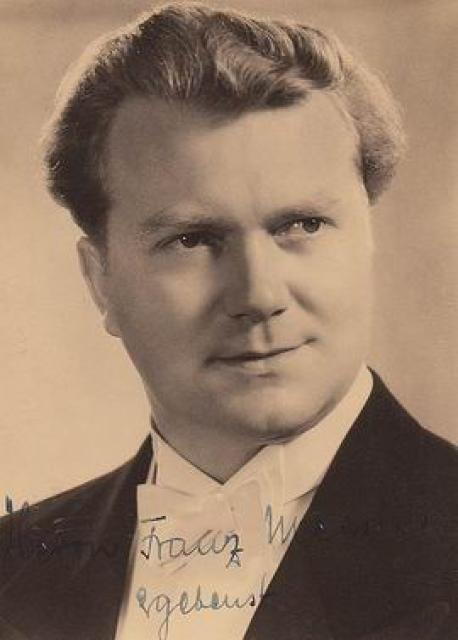
Gerhard Husch
 Germany
- Biography of Gerhard Hüsch
- Early Life and Career
- Opera Career
- Vocal Style and Recordings
- Later Career and Teaching
- Legacy and Death
Biography of Gerhard Hüsch
Introduction
Gerhard Hüsch was a German lyrical baritone who was one of the greatest German performers of the 20th century. Specializing in romances and German and Italian opera, he had a successful career both in Germany and internationally.

Early Life and Career
Gerhard Hüsch was born on February 2, 1901, in Hanover, Germany. Initially pursuing acting, he later turned to singing and gained experience in provincial German theaters. He also showed his talent as a brilliant comedic actor. From 1925 to 1944, Hüsch was regularly invited to perform in Berlin, including at the Berlin State Opera, as well as several other major theaters in Germany and Austria. He also performed abroad at the Royal Opera House in Covent Garden, London, and La Scala in Milan during the 1930s, the peak of his international career.
Opera Career
Hüsch was renowned for his portrayal of Papageno in Mozart's "The Magic Flute." He recorded the complete role of Papageno for HMV in 1937-1938, conducted by Sir Thomas Beecham and accompanied by the Berlin Philharmonic Orchestra. His operatic repertoire mainly consisted of roles typical for a lyrical baritone, including those in Wagner's operas. Hüsch was invited to participate in the annual Bayreuth Festival, and his performances as Wolfram in "Tannhäuser" in 1930 and 1931 under the baton of Arturo Toscanini were particularly acclaimed. He was also well-acquainted with the vocal works of Richard Strauss and performed at the premiere of his opera "Intermezzo." Hüsch performed alongside the best German sopranos, mezzo-sopranos, tenors, and basses between the two world wars, and Bruno Walter became his third famous conductor after Beecham and Toscanini.
Vocal Style and Recordings
Unlike his famous contemporaries, the heroic baritones Hans Hotter and Rudolf Bockelmann, who impressed with the power of their voices, Hüsch possessed a lighter vocal strength. However, he had a beautiful, clear, and smooth singing style and impeccable diction, similar to the lyrical baritone Heinrich Schlusnus, who was 13 years his senior and somewhat of a rival to Hüsch. Hüsch's outstanding vocal qualities are evident in his pre-war recordings of romances. He recorded Schubert's song cycles "Winterreise" and "Die Schöne Müllerin" as well as Beethoven's composition "An die ferne Geliebte." His recordings of Hugo Wolf's songs also gained the composer thousands of new fans. Hüsch also enjoyed recording songs by Hans Pfitzner and Yrjö Kilpinen. Occasionally, he also performed choral works, including Bach's "St Matthew Passion."
Later Career and Teaching
After World War II, Hüsch, who had been politically naive and associated with high-ranking Nazis during the Third Reich, mainly withdrew from concert and opera performances and focused on teaching. He became a professor at the Munich Hochschule für Musik, where British tenors Nigel Rogers and James King were among his students. He conducted master classes in Europe and traveled to Japan in 1952-1953. From 1977 to 1981, Hüsch taught at the Indiana University School of Music in Bloomington, Indiana, and conducted seminars on German romance. He later conducted master classes at the University of Texas at Austin and taught at the University of Colorado at Boulder in 1982.
Legacy and Death
Gerhard Hüsch passed away on November 23, 1984, in Munich at the age of 83. Today, a significant portion of his recordings is reissued on CD by various companies, ensuring his legacy lives on.


