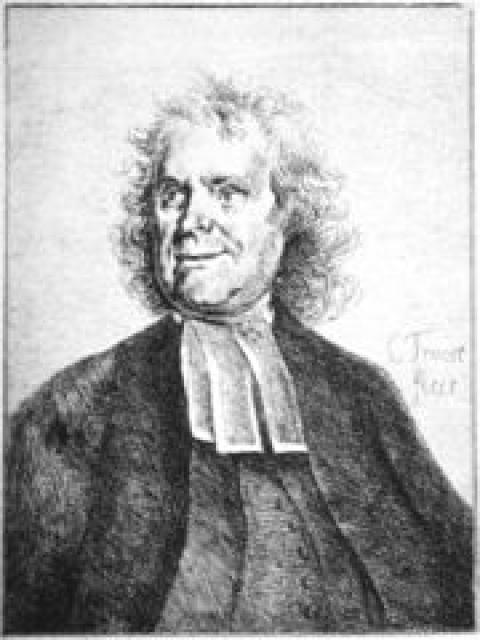
German Burgave
 Netherlands
- Herman Boerhaave, the Renowned Physician of the 18th Century
- The Healing Hand
- Medical Luminary
- Advocate for Precision
Herman Boerhaave, the Renowned Physician of the 18th Century
Herman Boerhaave, one of the most esteemed physicians of the 18th century, was born in 1668 in the quaint village of Voorhoude, nestled on the outskirts of Leiden, the Netherlands. By the tender age of eleven, he had delved into the depths of Latin, Greek, and the liberal arts under the tutelage of his father.
The Healing Hand
Legend has it that a persistent ulcer on Boerhaave's leg plagued him for seven years, defying the remedies of the day. Yet, it was his own triumph over this ailment that sparked his lifelong calling. Bereft of his father at fifteen, Boerhaave ventured to Leiden, immersing himself in history, natural philosophy, logic, and even Hebrew and Chaldean languages to decipher the original texts of Scripture. Despite his father's aspirations for a spiritual career, the intolerance of the clergy towards independent thought propelled him towards medicine.
After receiving his doctorate from Hardervijk University, Boerhaave became professor of medicine in Leiden in 1701. His chair of botany and medicine followed in 1709. This period marked the publication of his seminal works, "Institutiones" and "Aphorisms," which served as explanatory texts for his lectures. In 1715, he assumed the professorship of practical medicine and established a hospital where he meticulously demonstrated the art of diagnosing and treating diseases to his students. Despite his reluctance, the university entrusted him with the professorship of chemistry in 1718. Boerhaave embodied an entire faculty within himself, as one of his biographers wittily observed. Notably, he introduced lectures on eye diseases in the Netherlands. He met his end on September 23, 1738, succumbing to heart disease.
Medical Luminary
Boerhaave's practical prowess matched his theoretical brilliance. Patients flocked to him from far and wide, even monarchs who deemed it no disgrace to seek his counsel. His reputation extended beyond borders, as evidenced by the letter he received from a Chinese mandarin, addressed simply to "Boerhaave, Physician in Europe." Leiden expanded its fortifications and erected countless homes to accommodate his numerous students. His first appearance after a six-month illness was greeted with public illumination in the city. After his demise, Leiden erected a simple yet dignified monument bearing the inscription, "Salutifero Boerhaavii genio sacrum," honoring his healing legacy.
Leaving behind an inheritance of four million francs, Boerhaave faced accusations of avarice. However, his philanthropy, veiled in secrecy, belied this claim. His contributions to medical science were profound. He proposed the origin of nerves in the gray matter of the brain and spinal cord, disseminated the accurate understanding of cataracts, and explored mercury and antimony treatments for smallpox.
Advocate for Precision
In his inaugural address "De commendando studio Hippocratico," Boerhaave emphasized the efficacy of few but well-chosen remedies and cautioned against speculative theories. He viewed the study of medical history as a beacon in the labyrinth of medical systems and believed that tangible observations were the foundation of knowledge. He maintained that metaphysical inquiries remained beyond the reach of physical methods. Guiding himself by these principles, he taught his students, among them luminaries such as Haller, van Swieten, de Gaen, and Pringle, to approach medicine with meticulousness.
His enduring legacy lies not in dogmatic doctrines but in his unwavering advocacy for precision in medical practice, both through his lectures and writings. Boerhaave's "Institutiones medicae" and "Aphorismi" served as foundational texts for medical education for generations. By championing the virtues of observation and critical thinking, he left an enduring mark on the annals of medicine.


