
Gertrude Grob-Prandl
 Austria
Biography of Gertrude Grob-Prandl
Gertrude Grob-Prandl was an Austrian opera singer and a Wagnerian soprano. She was born in Vienna on November 11, 1917, and studied at the Vienna Conservatory. Initially, she planned to become a piano teacher at the insistence of her father. However, after a performance of Beethoven's Ninth Symphony, her vocal abilities were recognized, and she was directed to pursue singing.
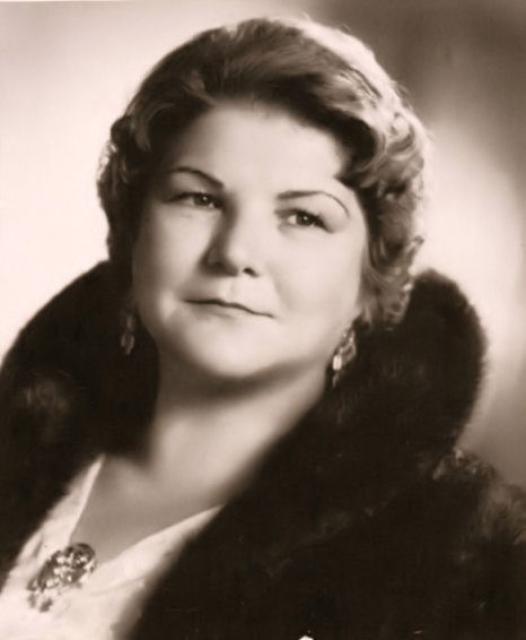
Before completing her four-year academic course, Grob-Prandl signed a contract with the Vienna Volksoper. She made her debut at the Volksoper in 1939, portraying the role of Santuzza in "Cavalleria Rusticana." She immersed herself in dramatic repertoire, performing roles such as Leonore, Elisabeth, Turandot, and Ariadne in Richard Strauss's works. Additionally, she had an extensive repertoire of Italian roles, performing them in the German language.
In 1944, Grob-Prandl joined the Vienna State Opera, where she worked for almost 30 years. However, from 1945 to 1947, she served as the leading dramatic soprano in Zurich. Known for her powerful voice, she was considered one of the strongest heroic sopranos of her generation, surpassing renowned singers such as Birgit Nilsson, Kirsten Flagstad, and Gwyneth Jones. Astrid Varnay, a Swedish mezzo-soprano, even remarked that the walls would tremble when Grob-Prandl sang the role of Turandot. There was an anecdote that during one performance, the fire brigade interrupted the show because people outside the theater mistook Grob-Prandl's voice for a fire siren.
Grob-Prandl's fame in Italy overshadowed her popularity in her native Austria. Her voice was not only powerful but also possessed remarkable purity and flexibility, allowing her to control it as an impeccable instrument without any hint of heaviness. Unlike many other Wagnerian performers, she effortlessly sang works from different composers and eras. While she had to work hard for the elegant passages in Mozart's roles, her dramatic roles were sung with strength and rare lyricism.
During World War II, the Vienna State Opera was destroyed by Allied bombings and was only rebuilt in 1955. During this time, Grob-Prandl performed in 35 productions of the operetta "Die Fledermaus" as Rosalinde, which she considered a luxury that she could not experience before or after the war. In 1949, she participated in the Salzburg Festival, and under the baton of Clemens Krauss, she sang her first Brünnhilde in "Die Walküre." She later took on the roles of Brünnhilde in "Siegfried" and "Götterdämmerung" under the conductor Rudolf Moralt. Her success led to her being awarded the honorary title of Kammersängerin.
Grob-Prandl found great pleasure in working with Victor de Sabata in Italy, praising his interpretation of "Tristan und Isolde" as elegant and poetic. In 1951, she performed the role of Turandot in English at Covent Garden. It was her exceptional performance of Turandot that captured the hearts of the Italian audience, who admired her passionate high notes.
Bayreuth and America eluded her, except for the 1953 season in San Francisco when she sang Brünnhilde in "Die Walküre," Isolde, and Amelia. In the United States, Birgit Nilsson dominated the Wagnerian scene, which resulted in fewer invitations for Grob-Prandl. Apart from regular performances in Italy and occasional engagements in other European theaters, Grob-Prandl primarily performed in her beloved Vienna. She retired from the stage in 1972 when her voice was still in perfect condition.
Gertrude Grob-Prandl passed away on May 16, 1995, in Vienna. She left behind a series of recordings, including Donna Anna in "Don Giovanni," First Lady in "Die Zauberflöte," Brünnhilde, Isolde, Turandot, Elektra by Richard Strauss, and Elektra in "Idomeneo."


