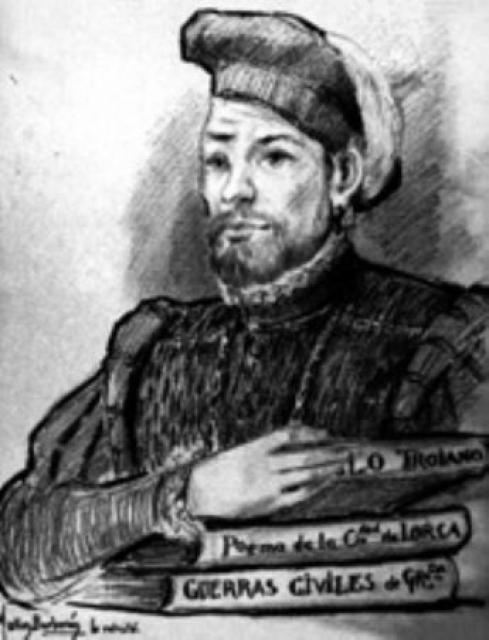
Gines Perez de Hita
 Spain
Spain- Ginés Pérez de Hita
- Literary Beginnings
- Rise to Fame with "The History of the Civil Wars in Granada"
- Historical Chronicle and "Second Part"
- Influence and Legacy
Ginés Pérez de Hita
Early Life and Military ServiceGinés Pérez de Hita, a celebrated Spanish author and chronicler, was born circa 1544 in the province of Murcia. Although details of his early life remain obscure, indirect evidence suggests Mula as his birthplace, where the Hita surname was prevalent. From 1569 to 1571, he fought in the suppression of the Morisco rebellion, where he purportedly displayed remarkable compassion and humanity. He claimed to have spared nearly two dozen women and an infant during the destruction of the city of Felix.
Literary Beginnings
After the war, Hita returned to Murcia and penned "Book of the Inhabitants and Exploits of the City of Lorca" in 1572, a poem that failed to gain widespread recognition. His second poetic endeavor, "Seventeen Books of Dares on the Trojan War," was an adaptation of a Spanish account of the Latin "Historia Destructionis Troiae" by Guido delle Colonne.
Rise to Fame with "The History of the Civil Wars in Granada"
Hita achieved significant success with his prose work "The History of the Civil Wars in Granada," published in Zaragoza in 1595. This tale of Granada's final years of Muslim rule intertwined chivalric romance, Moorish aesthetics, and historical descriptions of Andalusia. It is widely considered one of the earliest European historical novels.
Historical Chronicle and "Second Part"
Inspired by the success of "The History of the Civil Wars in Granada," Hita embarked on a memoir-like chronicle, recounting his firsthand experiences in the Morisco rebellion. However, he titled it "Second Part of the Civil Wars in Granada," linking it to the earlier work. This composite creation became known as "The Civil Wars in Granada."
Influence and Legacy
The two parts of "The Civil Wars" sparked renewed interest in the events of the Reconquista, showcasing the fortunes of former enemies and earning them the reader's respect. Hita's work initiated the "Granadian genre" in Spanish literature, influencing playwrights such as Lope de Vega and Calderón de la Barca. The second part inspired plays by Calderón and Francisco Martínez de la Rosa.
The idyllic "Tale of Segurí and Abencerraje," included in "The History of the Civil Wars," influenced sentimental and romantic literature, inspiring works by Madeleine de Scudery, Madame de Lafayette, John Dryden, and others.
Hita's work was translated into French in 1608, German in 1821, and English by Thomas Rodd in 1801, introducing it to influential figures like Walter Scott. Today, his work remains an important contribution to Spanish literature, marking him as one of the pioneers of the historical novel.


