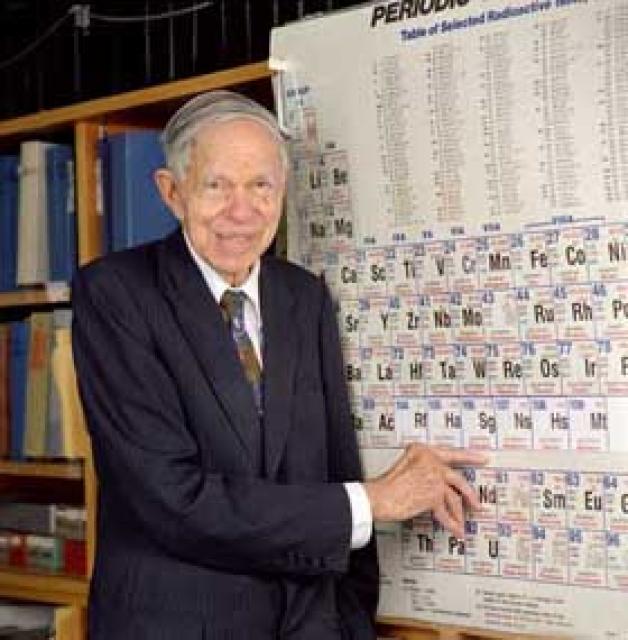
Glenn Theodore Seaborg
 USA
USABiography of Glenn Theodore Seaborg
Glenn Theodore Seaborg was an American physicist who was awarded the Nobel Prize in Chemistry in 1951 for his work on the synthesis of plutonium and other transuranium elements. He was born on April 19, 1912 in Ishpeming, Michigan.
Seaborg graduated from the University of California, Los Angeles in 1934 and obtained his Ph.D. from the University of California in 1937. He became a professor in 1945 and served as the President of the University of California from 1958 to 1961.
His work on the synthesis of transuranium elements was of significant importance for the development of atomic energy and the creation of the atomic bomb. Along with Edwin McMillan, Seaborg synthesized plutonium from uranium (1940-1941) and participated in the discovery of several other transuranium elements such as americium, curium (1944), berkelium (1949), and others.
In 1942, Seaborg proposed the existence of the actinide series, which played a crucial role in predicting the properties of heavy transuranium elements. From 1942 to 1946, he worked at the Metallurgical Laboratory in Chicago on industrial-scale production of plutonium for the atomic bomb.
Seaborg served as a member of the General Advisory Committee of the Atomic Energy Commission (AEC) from 1946 to 1950. He was also the director of the Radiation Laboratory at Berkeley from 1954 to 1956 and from 1971 onwards, succeeding Ernest Lawrence. From 1961 to 1971, he held the position of Chairman of the AEC.
Seaborg received numerous awards and honors throughout his career, including the Perkins Medal (1957), Benjamin Franklin Medal (1963), and the Enrico Fermi Award (1959). He passed away on February 25, 1999 in Lafayette, California.


