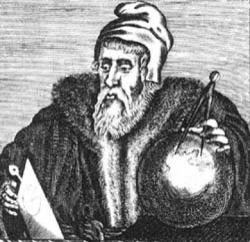
Guidobaldo del Monte
 Italy
Italy- Guido Ubaldi del Monte: A Renaissance Polymath
- Early Life and Education
- Military Service and Scientific Pursuits
- Patronage of Galileo
- Scientific Contributions
- Later Life and Legacy
Guido Ubaldi del Monte: A Renaissance Polymath
Guido Ubaldi del Monte, born in the Italian city of Pesaro in the 16th century, stands out as a multifaceted figure whose contributions spanned the realms of mathematics, mechanics, astronomy, and philosophy. He is particularly renowned for his patronage of the brilliant physicist and astronomer Galileo Galilei.
Early Life and Education
Born into an aristocratic family, Ubaldi del Monte received his education at the court of Urbino. In 1564, he enrolled at the University of Padua, where his passion for science blossomed. It was here that he developed a close friendship with the poet Torquato Tasso.
Military Service and Scientific Pursuits
After graduating, Ubaldi del Monte participated in military campaigns against the Ottoman Turks as a fortifications engineer. Upon his return, he settled in his family estate and dedicated his time to scientific investigations, focusing primarily on mathematics, astronomy, and physics. He studied under the renowned mathematician Federico Commandino, and formed a close bond with another student, Bernardino Baldi.
Patronage of Galileo
In 1588, Ubaldi del Monte was appointed General Inspector of Fortifications for Tuscany. Around this time, he identified the exceptional talent of the young Galileo Galilei, then an impoverished physicist and mathematician. Ubaldi del Monte became Galileo's patron and, through the intercession of his brother, presented him to the Grand Duke of Tuscany, Ferdinand I de' Medici. This introduction secured Galileo his first academic appointment at the University of Pisa. Three years later, Ubaldi del Monte once again supported Galileo's career by arranging his professorship at the University of Padua, where he made his famous telescopic discoveries.
Scientific Contributions
Ubaldi del Monte's scientific work, particularly in mechanics, earned him widespread respect in his time. His two treatises, "Book on Mechanics" (1577) and "Notes on Archimedes' Treatise on the Equilibrium of Plane Figures" (1588), delve into the principles of statics. He championed Archimedean statics, which focused on geometrical relationships, and criticized the kinematic approach. Notable in his work is the use of the "golden rule of mechanics" in solving the equilibrium problem of a pulley system, a concept he had previously rejected.
In his "Perspectives" (published in 1600), Ubaldi del Monte made significant contributions to mathematical perspective. He laid the foundation for understanding the convergence of parallel lines in perspective, a concept that had profound implications for artists, architects, and theater directors. Posthumously published, his astronomical work "On the Snail" examined aspects of planetary motion.
Later Life and Legacy
Ubaldi del Monte invented several instruments, including a drawing tool for constructing regular polygons and dividing lines into equal parts. He passed away in his family estate in 1607, leaving behind a legacy that influenced generations of scientists. His work on perspective remains an essential reference for artists and architects to this day.