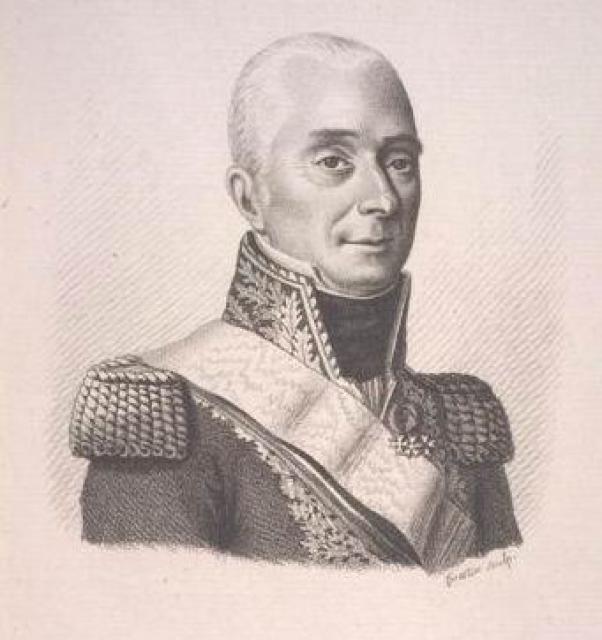
Guillaume Dumas
 France
- Early Life and Military Service
- French Revolution and Political Involvement
- Royalist Conspiracies and Return Under Napoleon
- Service in the Grande Armée and Beyond
Early Life and Military Service
Mathieu Dumas, a descendant of French nobility, was born on February 1, 1805, to a treasurer in Montpellier. At the tender age of fifteen, he enlisted in the French army and served as an adjutant to Count Puysegur. In 1773, he became a sub-lieutenant in the Chasseurs de Médoc infantry regiment. Rising through the ranks, he earned the rank of captain in 1780.
From 1780 to 1783, Dumas fought in the American Revolutionary War as part of the French expeditionary force led by Count Rochambeau. After the war, he joined an expedition to Jamaica and was promoted to major on July 10, 1783. His international service continued with a mission to the Levant in 1784-1785 and participation in the siege of Amsterdam in 1787, where he assisted the Dutch in their conflict with Prussia.
French Revolution and Political Involvement
In 1789, Dumas joined the staff of General Lafayette as a colonel. A pivotal figure in the establishment of the National Guard, he was appointed as the Director-General of the Military Depot on May 13, 1791. Promoted to Major-General (Maréchal de Camp) on June 10, 1791, he commanded troops in Metz. During King Louis XVI's failed escape attempt on June 23-25, Dumas accompanied the royal cortege.
In 1791, Dumas delved into politics, aligning with the Feuillants faction. He was elected to the Legislative Assembly and even served as its President for a period in 1792. Following the storming of the Tuileries Palace, Dumas fled first to England and then to Switzerland, returning to Paris only after the coup d'état of 9 Thermidor.
Royalist Conspiracies and Return Under Napoleon
Despite his monarchist leanings, Dumas remained politically active. In 1797, he helped establish the secret royalist society of Clichy. Elected to the Council of Elders, he was forced to flee France after the coup of 18 Fructidor. He sought refuge in Hamburg until the ascent of Napoleon Bonaparte after the coup of 18 Brumaire.
Upon his return to France, Dumas received orders to form a reserve army in Dijon, which later saw action at the Battle of Marengo. He served as Chief of Staff to General MacDonald from May 29, 1800, and as Ambassador to Naples from April 1801. On June 27, 1801, he became a member of the Council of State, and in October 1804, he commanded the staff of General Davout.
Service in the Grande Armée and Beyond
Dumas was appointed Second Aide-de-Camp to the Grande Armée in September 1805 and fought alongside Napoleon at Ulm, Elchingen, and Austerlitz. Transferred to the Army of Naples in January 1806, he served as Minister of War and Grand Marshal of the Court under King Joseph Bonaparte. When Joseph ascended to the Spanish throne, Dumas accompanied him and became Spain's Minister of War in July 1807.


