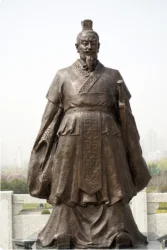
Han Fei
Han Fei (c. 280–233 BCE) was a Chinese political philosopher and member of the ruling house of the state of Han during the late Warring States period. His writings, later gathered under the title Han Feizi, became one of the most influential works associated with Legalist thought. He argued that rulers should rely on clear laws, administrative methods and carefully controlled rewards and punishments to govern a state.
Life and Education
The surviving account of Han Fei’s life comes mainly from Sima Qian’s Records of the Grand Historian, written about two centuries after his death. It identifies him as a prince of Han and says that he studied under the philosopher Xunzi alongside Li Si, who would later become a leading minister of Qin. Ancient sources say Han Fei had a stammer and found it easier to express himself through writing.
Han Fei’s state was increasingly threatened by the expanding power of Qin. He urged the Han ruler to strengthen government and use capable officials, but his advice was reportedly not adopted. He composed essays that criticized political corruption and argued that a state’s survival depended on effective institutions rather than reliance on inherited custom or the virtue of individual ministers.
Political Ideas
Han Fei drew together ideas associated with earlier thinkers, including Shang Yang, Shen Buhai and Shen Dao. His approach emphasized fa, or standards and laws; shu, the techniques by which a ruler supervises officials; and shi, the authority that comes with the ruler’s position. He believed that officials should be judged by measurable performance and that rewards and punishments should be applied consistently.
His writings often examined the gap between public claims and private motives. Han Fei was skeptical that rulers could depend on ministers’ loyalty or moral character alone. Instead, he outlined methods for keeping officials accountable while preserving the ruler’s control. The result was a hard-edged vision of statecraft that later helped shape the political institutions of imperial China.
Mission to Qin and Death
According to the traditional biography, Han Fei was sent as an envoy to Qin, whose king was impressed by his writings. His former fellow student Li Si and another official, Yao Jia, feared his influence, and Han Fei was detained. Li Si allegedly persuaded him to take poison in prison in 233 BCE. The story is preserved in later historical writing, and the exact circumstances cannot be independently confirmed.
Legacy
The Han Feizi, a collection of 55 chapters attributed to Han Fei, survived as a major text of early Chinese political thought. Its arguments influenced Qin statecraft and the first emperor’s unified empire, while later dynasties also drew on its techniques of law and administration. Though the label “Legalist” simplifies a diverse intellectual tradition, Han Fei remains its best-known and most systematic exponent.