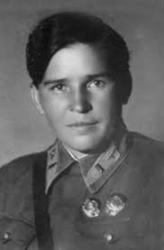
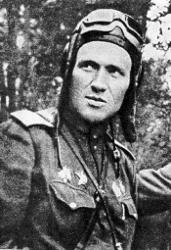
Hans-Ioahim Marsel
 Germany
Hans-Joachim Marseille - Biography
Hans-Joachim Marseille (1919-1942) was a fighter pilot of the Luftwaffe, one of the most renowned pilots of the Third Reich. His short military career became the stuff of legends. Marseille was born on December 13, 1919, in Charlottenburg, a suburb of Berlin. He was a descendant of French Lutherans who had fled to Brandenburg to escape religious persecution.
Hans' father, Siegfried Marseille, was a pilot during World War I, a police officer afterward, and later became a major general in the Wehrmacht, dying in combat on January 29, 1944, near the village of Novoselki. Due to his father's service, Hans' parents often lived apart, which may explain his aversion to all things military - the ideas, the discipline, the uniforms. However, he loved flying, and as soon as he turned 18, he joined the Luftwaffe.
Marseille proved to be a talented pilot but was reckless and frequently disciplined for attempting advanced maneuvers on training aircraft and other transgressions. To continue his service, he was assigned to JG-52, under the command of future commander of the West German Air Force, Johannes "Macky" Steinhoff, where he did nothing outstanding. Marseille claimed to have shot down seven enemy planes during the Battle of Britain, but only three of his victories were confirmed. This lack of discipline led to doubts about his claims. He himself was shot down at least four times, although some sources claim a higher number, but he always managed to reach the French coast with his damaged Bf. 109, either bailing out or crash-landing on a beach or field.
Marseille's personal file was filled with reports of his unworthy military conduct, his disregard for regulations, his long hair, and his sloppy attitude towards his duties. He behaved more like a "Don Juan" than a fighter pilot during this period of his military career. Marseille was quite handsome, and no woman could resist his charm. Women flocked to him, and sometimes after a wild night, he would be so exhausted that he couldn't fly the next day. Steinhoff had incredible patience with this immature young man, but even he had had enough. He recalled years later, "Marseille showed himself to be a capable fighter pilot but was completely unreliable. He was always surrounded by girlfriends, who drained him of so much energy that he had to be grounded. Marseille displayed an unacceptable lack of commitment to his duties, which was the main reason for his dismissal. But overall, he was a charming guy."
Rise to Fame
Humiliated, Marseille returned to Germany but not for long. In January 1941, he was assigned to JG-27, which was sent to Libya to bolster the battered Italian Royal Air Force (Regia Aeronautica). It was in North Africa that Hans-Joachim Marseille's talents truly shone. Two factors greatly contributed to this: firstly, there were no women in Luftwaffe bases in the desert, and secondly, his mentor was Major Edmund Neumann, a master of his craft. It didn't take long for "Jochen" to become the Luftwaffe's top sniper. Sometimes, after achieving six victories, he would return to his airfield having expended only half of his ammunition. Marseille needed on average just 15 rounds to shoot down an enemy aircraft. As a result, his disciplinary issues were forgotten, and Marseille, with 33 confirmed kills, was promoted to Feldwebel. In December 1941, Field Marshal Kesselring awarded him the German Golden Cross. The beautiful and refined young officer became immensely popular thanks to the efforts of the imperial Ministry of Propaganda, which used his image to boost the German people's fighting spirit. He received bags full of letters from fans, mostly female. He was dubbed the "African Eagle" and the Italians, who idolized him, nicknamed him the "Star of Africa." Mussolini awarded the pilot a gold medal for bravery, an honor that not even Erwin Rommel had received. However, unlike the "Desert Fox," Marseille didn't tell the Italian leader what he thought of him.
Final Days
On May 31, 1942, Field Marshal Rommel, determined to end the war in the desert as quickly as possible, launched an offensive. Providing air support, Marseille attacked several Curtiss Kittyhawk planes over Gazala and shot down six of them in just 11 minutes on June 3. Three days later, he was awarded an honorary sign for his 75 aerial victories. The fighting in North Africa was intense, and on June 17, 1942, Marseille achieved his 100th aerial victory. On that day, he downed 10 enemy planes, six of them in just seven minutes. The next day, Marseille was promoted to Hauptmann and sent back to Germany, where Hitler himself awarded him the Knight's Cross of the Iron Cross with Oak Leaves and Swords. Naturally, during his leave, he tried to answer the letters from his numerous admirers personally. Despite having a great time, Marseille couldn't shake off the tension caused by the continuous battles over the vast Libyan desert and appeared tired and drained.
On August 23, while Rommel's advance was halted near El Alamein, Marseille returned to his JG-27. There was a temporary lull in the North African theater of operations. Eventually, the "Desert Fox" attempted to break the deadlock and launched an offensive in the Alam el Halfa ridge area. Once again, Marseille and his squadron provided air support. On September 1, 1942, he made history by shooting down 17 British planes in a single day, a devastating blow that the Royal Air Force had never experienced before (the absolute record was set by Luftwaffe Major Emil Lang, who shot down 18 Soviet planes in one day). On this occasion, Hauptmann Marseille didn't celebrate his victory. That night, he lay in his bed with his eyes wide open, staring at the ceiling. Due to increased British air activity in September, he had not had a single day off. Fatigue didn't affect his flying skills.
Heinz Joachim Marseille, a fellow pilot, described him, "He knows his enemy's intentions in advance and strikes preemptively. Once he is absolutely sure his fire has destroyed the enemy, Marseille loses all interest and attacks the next aircraft." In September 1942, Marseille reached the pinnacle of his military career, shooting down an incredible 61 British planes in just one month. More than anyone else in history, including the Red Baron. By September 30, 1942, Marseille had 158 confirmed kills of British and Allied planes. On this day, he led his squadron over the outskirts of Cairo. He did not engage enemy aircraft. On his way back, Marseille's Bf. 109 suddenly filled with acrid black smoke. Jochen was suffocating but couldn't reach the territory occupied by Axis forces. Near El Alamein, he opened the canopy and ejected. Weakened by asphyxiation and blinded by the smoke, he didn't realize that his aircraft, out of control, began to nosedive. Marseille was caught in the airstream and struck the tail section with force. This impact likely killed him. Horrified, his comrades watched as Marseille's lifeless body fell onto the sand. His parachute never opened. "Jochen" was buried four miles south of Sidi Abdel Rahman, where he crashed. Hans-Joachim Marseille packed more into the short span of time fate allowed him than most people do in a lifetime. If he had lived for just two more months, he would have turned 23.