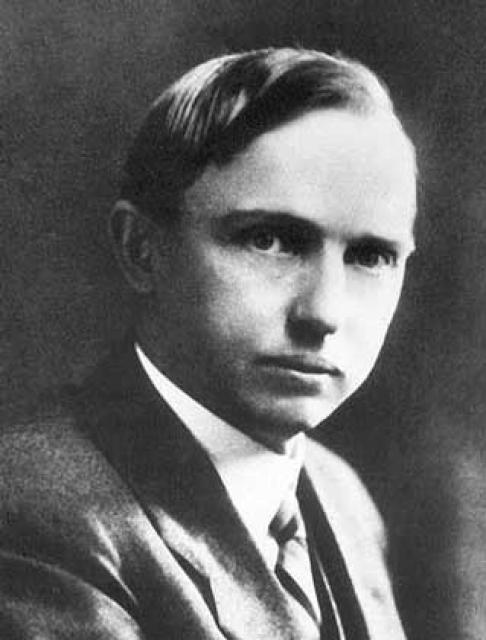
Harlow Shapley
 USA
USA- Harlow Shapley: American Astronomer and Social Activist
- Astronomical Discoveries
- The Great Debate and Harvard Observatory
- Social Contributions and Legacy
- Awards and Publications
- Final Years and Death
Harlow Shapley: American Astronomer and Social Activist
Early Life and EducationHarlow Shapley was born on November 2, 1885, in Nashville, Missouri. He earned a bachelor's degree from the University of Missouri (1910) and pursued graduate studies at Princeton University, where he specialized in eclipsing binary stars under Henry Norris Russell.
Astronomical Discoveries
At Mount Wilson Observatory (1914-1921), Shapley made significant contributions to understanding variable stars in globular clusters. He developed a method for determining the distance to remote stellar systems by observing Cepheid variable stars within them. This led to the realization that the size of our galaxy, the Milky Way, was far larger than previously believed.
The Great Debate and Harvard Observatory
Shapley's role in the "Great Debate" with Heber Curtis (1920) about the nature of galaxies earned him the directorship of the Harvard Observatory. He continued his research on extragalactic stellar systems, including variable stars in the Magellanic Clouds and the structural features and spatial distribution of other galaxies.
Social Contributions and Legacy
Beyond his scientific work, Shapley actively engaged in social causes. He dedicated himself to the development of Harvard Observatory, facilitated the invitation of foreign scientists to the United States, and participated in the establishment of UNESCO.
Awards and Publications
Shapley received numerous awards, including the Royal Astronomical Society's Gold Medal (1934). His popular science books, such as "Galaxies" (1943) and "Of Stars & Men" (1958), conveyed his passion for astronomy to a broader audience.
Final Years and Death
Harlow Shapley passed away on October 20, 1972, in Boulder, Colorado. His legacy as a renowned astronomer and dedicated social activist continues to inspire generations of scientists and scholars.