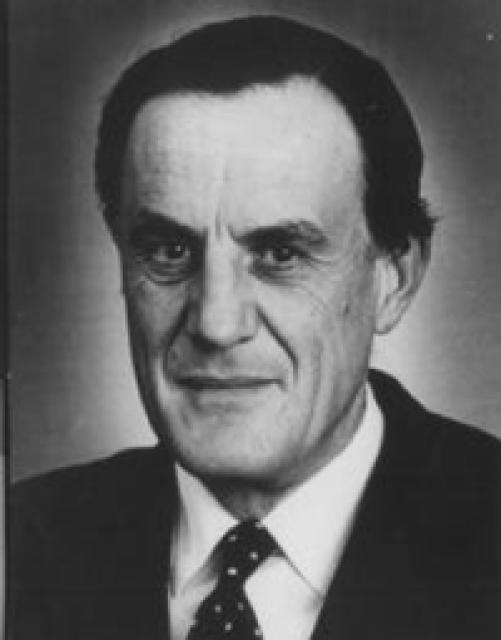
Robert Hanbury Brown
 India
India- Early Life and Education
- Military and Research Experience
- Academic Career and Research Contributions
- Interferometry and Stellar Diameter Measurements
- Honors and Recognition
- Conclusion
Early Life and Education
John Gatenby Bolton was born in India and received his education at Brighton Technical College and City and Guilds College of the University of London.
Military and Research Experience
From 1936 to 1947, Bolton conducted radio engineering research for various British military organizations. Subsequently, he worked at the University of Manchester from 1949 to 1963 (appointed Professor of Radio Astronomy in 1960).
Academic Career and Research Contributions
Radio AstronomyBolton's primary contributions lie in the field of radio astronomy. At the Jodrell Bank Observatory of the University of Manchester, he observed numerous sources of cosmic radio emission. In collaboration with C. Hazard in 1950, he made the groundbreaking discovery of radio emission from a normal galaxy (M31 in the constellation Andromeda). This observation indicated that the total emission from M31 was comparable to that of our own Galaxy, which is of the same type. Bolton went on to discover and study radio emission from other normal galaxies. He also identified several discrete sources of radio emission with peculiar galaxies and supernova remnants.
Interferometry and Stellar Diameter Measurements
In 1952, Bolton, along with R. Jennison and M. Das Gupta, developed a novel interferometric method for measuring the sizes of extended radio sources. He determined the angular sizes of some of these sources. In collaboration with R. K. Twiss, Bolton devised a theory for an optical intensity interferometer to measure the angular diameters of stars. In 1956, he constructed an intensity interferometer with 154 cm diameter mirrors at the Jodrell Bank Observatory. He later built a larger interferometer with 6.6 m diameter mirrors at the Narrabri Observatory in New South Wales. These interferometers were used to successfully measure the diameter of Sirius and several dozen other bright stars, determining their surface temperatures and refining the temperature scale for hot stars.
Honors and Recognition
Bolton served as President of the International Astronomical Union from 1982 to 1985. He received prestigious awards, including the Holweck Prize of the French Physical Society (1959), the Eddington Medal of the Royal Astronomical Society (1968), the Hughes Medal of the Royal Society (1971), and the Lyle Medal of the Australian Academy of Science (1971).
Conclusion
John Gatenby Bolton's pioneering research in radio astronomy significantly expanded our understanding of the universe. His contributions to interferometry and stellar diameter measurements revolutionized how astronomers study the properties of stars and galaxies. His legacy as a leading scientist and influential figure in astronomy endures to this day.