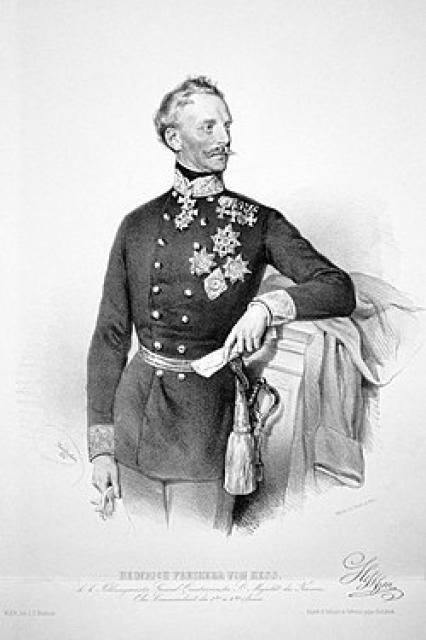
Heinrich Hess
 Austria
- Early Life and Military Career
- Collaborating with Radetzky
- Transforming the Austrian Army
- Revolutionary Campaigns
- Recognition and Honors
- Further Missions and Military Command
- Late-Career Assignments
- Legacy and Resting Place
Early Life and Military Career
Beginnings and Rise to ProminenceHeinrich Hess von Hessenstein was an Austrian military commander who began his service in the Austro-Hungarian army in 1805 as a staff officer. He distinguished himself as a senior lieutenant at the battles of Aspern-Essling and Wagram. By 1813, he had risen to the rank of captain and returned to staff work. During the Hundred Days, he served as a major on the staff of Field Marshal Karl Philipp, Prince of Schwarzenberg.
Collaborating with Radetzky
A Dynamic PartnershipIn 1831, Hess became Chief of Staff to Field Marshal Joseph Radetzky von Radetz, the commander-in-chief of Austrian Italy. This marked the beginning of a renowned collaboration, hailed as a classic example of harmonious cooperation between a commander and his chief of staff, similar to that of Gebhard von Blücher and August von Gneisenau.
Transforming the Austrian Army
A Progressive LeaderBased on Radetzky's military ideas, Hess developed innovative training plans for each branch of the army. Under their leadership, the Austrian forces in northern Italy achieved a heightened state of readiness, making them among the finest in Europe. From 1834 to 1848, Hess held posts in Moravia and Vienna, attaining the rank of Field Marshal Lieutenant in 1843.
Revolutionary Campaigns
Guiding the Army in WarWith the outbreak of revolution and war in Italy, Hess was immediately dispatched to Radetzky as Chief of Staff. His intimate knowledge of the enemy proved invaluable in the subsequent campaigns against Charles Albert, culminating in the victory at Novara.
Recognition and Honors
A Decorated CommanderHess's contributions earned him numerous accolades, including the Russian Order of Saint George, 2nd class, and the Commander's Cross of the Austrian Order of Maria Theresa. In 1850, he became a Privy Councillor and Field Marshal, assuming the leadership of the Imperial General Staff.
Further Missions and Military Command
A Trusted Envoy and StrategistHess frequently undertook diplomatic missions to various European capitals. During the Crimean War, he commanded Austrian forces in Galicia and Transylvania, forcing Russia to abandon its hold on Moldavia and Wallachia.
Late-Career Assignments
Advisor and Captain of the GuardIn 1859, Hess was appointed Chief of Staff to Emperor Franz Joseph I, who had taken over supreme command. After the defeat at Solferino, Hess negotiated the armistice at Villafranca. He was promoted to Field Marshal in 1860 and became Captain of the Drabanter Guard upon his retirement from the Imperial General Staff the following year.
Legacy and Resting Place
A Celebrated GeneralHeinrich Hess von Hessenstein's grave is located in the Vienna Central Cemetery, a testament to the esteemed legacy he left behind. As a brilliant military tactician and trusted advisor, he played a pivotal role in shaping the Austrian army and its campaigns throughout the 19th century.