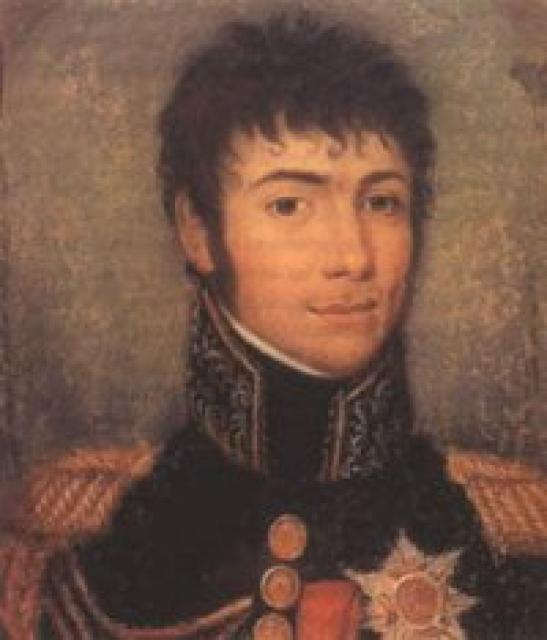
Henri Gatien Bertrand
 France
- Henri-Gatien Bertrand: A Devotion to Napoleon
- Service Under Napoleon
- Distinguished Service
- Years of War and Exile
- Post-Napoleonic Life
Henri-Gatien Bertrand: A Devotion to Napoleon
Early Life and Military InitiationHenri-Gatien Bertrand was born on March 28, 1773, in Châteauroux, France. Despite his family's intention for him to pursue a civil career, the outbreak of the French Revolution kindled his passion for military service. Bertrand joined the Engineers Corps and studied at the Military School in Mézières. He subsequently fought in the Pyrenees Theater of the War of the First Coalition.
Service Under Napoleon
In 1797, Bertrand served in the French embassy to Constantinople. He later accompanied Bonaparte to Egypt, where he distinguished himself in the Battle of the Pyramids and sustained a minor wound at Abukir. In 1800, he became a Brigadier General and commanded the Alexandria fortress.
Napoleon recognized Bertrand's military prowess during the Boulogne Camp, leading to his appointment as Napoleon's aide-de-camp after the Battle of Austerlitz. Bertrand remained a close associate throughout Napoleon's campaigns, both in victory and defeat.
Distinguished Service
In 1806, Bertrand participated in the Battles of Jena and Auerstädt. He played a crucial role in capturing the fortress of Spandau. In 1807, he fought in the Battles of Eylau and Friedland, earning a promotion to Divisional General. In 1808, he was bestowed the title of Count of the French Empire.
During the Austrian Campaign of 1809, Bertrand coordinated a remarkable river crossing at Aspern and fought valiantly at Wagram. In the Russian Campaign of 1812, his military abilities earned him the title of Grand Marshal of the Imperial Palace.
Years of War and Exile
Bertrand continued to serve loyally in the battles of 1813 and 1814. He was present at Napoleon's abdication at Fontainebleau and accompanied him to the island of Elba. After Napoleon's return to France, Bertrand fought in the Hundred Days campaign and followed him to Saint Helena island.
Post-Napoleonic Life
After the Bourbon Restoration, Bertrand was sentenced to death in 1816. However, after Napoleon's death, he returned to France in 1821 and was pardoned by the King. He regained his ranks, honors, and titles.
During the July Revolution of 1830, Bertrand became the head of the École Polytechnique and represented the Indre department in the Chamber of Deputies. From 1836 to 1840, he served as the governor of Martinique.
Bertrand died on January 15, 1844, in Châteauroux. His name is inscribed on the Arc de Triomphe in Paris, a testament to his unwavering devotion to Napoleon and his exceptional military service.