Henrik Dobzhanskiy
 Poland
- Biography of Henryk Dobzhansky
- War Hero
- Accomplished Equestrian
- Second World War
- Final Battle and Legacy
Biography of Henryk Dobzhansky
Early LifeHenryk Dobzhansky was born into a Polish noble family and was a direct descendant of the renowned knight Zawisza the Black. He grew up in Poland and developed a passion for sports and military service from a young age.
War Hero
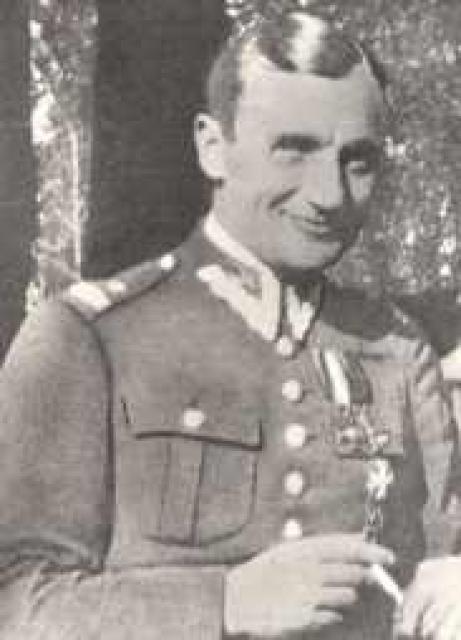
During the First World War, Dobzhansky volunteered to join the newly formed Polish Legions in Austria-Hungary. As a part of the 2nd Uhlans Regiment, he fought in battles under Stravchanami and Raranchei. After the establishment of independent Poland, he joined the Polish Army and commanded a cavalry platoon in the battles against the Ukrainian army for Lviv.
During the Soviet-Polish War of 1919-1921, Dobzhansky fought against the Red Army. His bravery earned him the highest Polish military honor, the "Virtuti Militari" (Silver Cross). Even in peacetime, Dobzhansky remained in military service.
Accomplished Equestrian
As an experienced equestrian, Dobzhansky was a member of the Polish national equestrian team. He won 22 gold, 3 silver, and 4 bronze medals in various equestrian competitions. In 1925, he achieved the title of the best rider in London, and in 1928, he served as a reserve at the Olympic Games in Amsterdam.
Second World War
In 1927, Dobzhansky was promoted to the rank of major. In the summer of 1939, he was appointed as the Deputy Commander of the 110th Reserve Uhlans Regiment. When the Second World War broke out in September 1939, Major Dobzhansky fought against German and Soviet forces, particularly defending Grodno.
After Grodno fell on September 23rd, the Polish troops defending the city retreated to neutral Lithuania and were interned. However, the 110th Uhlans Regiment, under the leadership of Colonel Józef Dombrowski, refused to follow such orders and headed to help the besieged Warsaw. On their way, they were surrounded by Soviet forces but managed to break through at a great cost. Colonel Dobzhansky and approximately 180 soldiers continued their journey. However, they did not reach Warsaw on time, as the capital surrendered on September 27th. Dobzhansky and around 50 soldiers headed south, intending to make their way to France. On October 1st, they crossed the Vistula River, engaged in battle with the Germans, and then decided to stay in the Sventokshi Mountains to await the arrival of the Allies.
Final Battle and Legacy
Continuing to fight, Dobzhansky inflicted significant losses on the Germans. In March 1940, he defeated a Wehrmacht infantry battalion near Huciska and severely damaged another German unit near Shalasy a few days later. To eliminate the "mad major's" squad, the Germans formed a special anti-partisan group consisting of SS, infantry, and tank units. In this operation against the partisans, numbering no more than 300, the Germans deployed 8,000 soldiers. On April 30th, 1940, Dobzhansky's unit was surrounded, possibly due to betrayal, and after a fierce battle, they were defeated. Dobzhansky died with a weapon in his hands. The Germans desecrated his body and put it on public display before, according to some reports, burning it. His final resting place remains unknown.
In 1966, Dobzhansky was posthumously promoted to the rank of colonel and awarded the "Virtuti Militari" (Golden Cross). His story has been captured in the film "Hubal" (1973) and several books.