Aleksey Botyan
 Belarus
- Biography of Alexei Botyan
- Early Life and Military Service
- Great Patriotic War
- Post-War Period
- Botyan was fluent in German, Polish, and Czech languages.
- He lived in Moscow.
Biography of Alexei Botyan
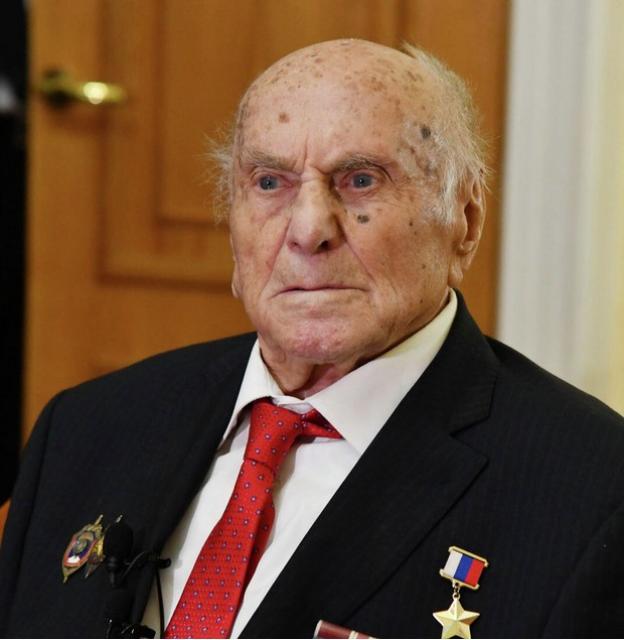
Alexei Nikolaevich Botyan was a former Soviet intelligence officer and a retired colonel of the Soviet KGB. He was also a veteran of World War II and was awarded the title of Hero of the Russian Federation in 2007. Botyan played a significant role in the preservation of the city of Krakow from destruction by German forces. He was one of the prototypes for the main character in Julian Semenov's novel "Major Vihor" and the film adaptation of the same name.
Early Life and Military Service
Alexei Botyan was born on January 28, 1917, in a peasant family in the Volozhin district of the Minsk region, on the territory that later became part of Poland. His father was a carpenter. Botyan completed his schooling and graduated from a pedagogical institute in 1935. At the age of 22, he was drafted into the Polish army and served as a corporal in the anti-aircraft artillery division in Vilnius. He participated in battles against the German invasion of Poland in September 1939.
When the western regions of Belarus were occupied by Soviet troops in September 1939, Botyan returned to his hometown and became a citizen of the USSR. In 1940, he completed pedagogical courses and worked as the head of an elementary school in the village of Rovkovichy. He was also an activist in the Komsomol, the Soviet youth organization. In 1940, according to his own recollections, Botyan was included in the reserve of the NKVD, the Soviet security agency.
Great Patriotic War
In May 1941, Botyan was enrolled in the NKVD and sent to the Higher Intelligence School for training. In July 1941, he was assigned to the Special Motorized Rifle Brigade, which was subordinated to the fourth department of the NKVD (headed by Pavel Sudoplatov).
In November 1941, Botyan was sent behind enemy lines as the commander of a reconnaissance and sabotage group. He participated in the defense of Moscow. In 1942, he was sent to the enemy's rear in western regions of Ukraine and Belarus, where he operated both independently and as part of large partisan units.
He served as the deputy head of intelligence for the partisan formation led by Hero of the Soviet Union Viktor Karasyov. Under his direct leadership, an operation was carried out to blow up the German Gestapo headquarters in the city of Ovruch, Zhytomyr region, Ukraine, when an inspection from Germany was present. As a result of this operation on September 9, 1943, 80 German officers were killed.
In May 1944, Botyan led a group of 28 people to Poland with the task of conducting reconnaissance on the location and movement of the enemy in the Krakow area. Due to his good knowledge of the Polish language and culture, as well as his organizational skills, Botyan was able to establish cooperation and joint military operations with various political forces, such as the Army of the Krakow District, the People's Army, and the Peasant Battalions. Under his leadership, an operation was carried out, together with units of the People's Army, to capture the city of Ilza, during which Polish patriots arrested in prisons were freed and a large amount of weapons and equipment was seized. A monument was later erected in Ilza to commemorate the heroes of this battle, which includes the names of both Polish fighters and Soviet soldiers from Botyan's group. The group led by Alexei Botyan managed to establish itself in the Krakow area and carry out extensive reconnaissance and sabotage activities. In late 1944, the group captured an engineer-cartographer named Zygmunt Ogarek, an ethnic Pole who had been conscripted into the German army and served in rear units of the Wehrmacht. Ogarak provided valuable information about an explosives depot transported to the Yagellonian Castle in the city of Nowy Sacz, which was rumored to be intended for the destruction of Krakow's historical center, the Rospuda Dam, and the bridges over the Dunajec River. Alexei Botyan infiltrated the castle posing as a Polish patriot porter and placed a time-delayed mine. On the morning of January 18, 1945, during the Red Army's offensive, the mine was detonated, and the enemy depot exploded. The next day, on January 19, the vanguard units of the 1st Ukrainian Front, commanded by Marshal of the Soviet Union Ivan Konev, entered Krakow. The city was virtually unharmed during the fighting (only a few bridges over the Vistula River were destroyed).
In modern-day Poland, Alexei Botyan's role in the preservation of Krakow is being called into question.
During the final months of the war, Botyan's group operated behind enemy lines on the occupied territory of Czechoslovakia.
Post-War Period
Starting from 1945, Botyan served in the operational unit of the 1st Directorate (foreign intelligence) of the USSR Ministry of State Security (later the Ministry of State Security and then the Committee of State Security). In 1947, he was sent to Czechoslovakia under the guise of a Czech worker and worked as a locksmith at a factory in the town of Zatec in the Sudetenland. He also studied at the Higher Industrial Motor Engineering School in Zatec. He made several trips abroad to various European countries for complex and responsible assignments, the details of which are still classified.
He was involved in providing consultations to the special-purpose group "Vympel."
In 1983, Botyan retired from active service at the rank of colonel due to age (at the age of 66). He continued to work as a civilian specialist in the KGB of the USSR until 1989.
Botyan was fluent in German, Polish, and Czech languages.
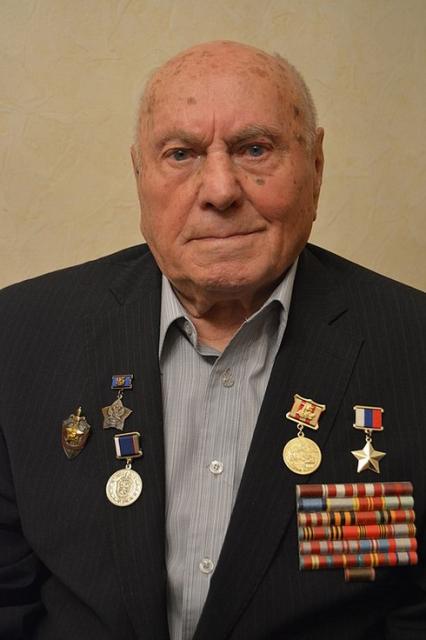
In May 2007, by the decree of the President of the Russian Federation, Botyan was awarded the title of Hero of the Russian Federation for his courage and heroism displayed during the operation to liberate the Polish city of Krakow and prevent its destruction by German fascist invaders during the Great Patriotic War of 1941-1945. He was also awarded the Gold Star medal.
He lived in Moscow.
Death and FamilyIn late January 2020, Botyan's health deteriorated sharply, and he was admitted to a hospital in Moscow. On February 13, 2020, at the age of 104, the intelligence officer passed away. President Vladimir Putin expressed his condolences on his death.
Botyan was buried on February 17, 2020, with military honors at the Alley of Heroes in the Troekurovo Cemetery.
His father, Nikolai Botyan, was a carpenter who worked in Germany and Argentina and was fluent in German and Spanish. He taught his son the German language.
Botyan's wife, Galina Vladimirovna Botyan (nee Gintsel), was of Czech origin. She passed away in 2013.
He had a daughter, Irina Alexeevna Botyan, and several grandchildren, as well as two great-grandchildren.




