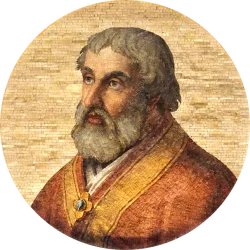
Honorius I
Honorius I served as pope during a period when the Byzantine Empire and the Roman church were struggling to find language that could reconcile competing accounts of Christ’s human and divine nature. His correspondence with the patriarch of Constantinople became central to that debate. Decades after his death, an ecumenical council condemned him, making his pontificate one of the most debated in the history of the papacy.
Early Life and Election
Honorius was born in Campania, in southern Italy, to a family connected with the Roman church. Little is known about his early years. He was elected bishop of Rome in 625 and served until his death in 638.
His pontificate included practical administration of the church’s property and relations with rulers across Italy. He supported church building and restoration in Rome and maintained contact with Christian communities beyond the city, including in England.
The Monothelite Controversy
In the early seventh century, Christian leaders debated how to describe the relationship between Christ’s divine and human natures. Patriarch Sergius I of Constantinople asked Honorius for guidance on language concerning Christ’s “one will.” Honorius advised avoiding contentious terms about one or two operations and wrote that there was one will in Christ, while emphasizing that Christ’s human nature was not opposed to the divine.
The wording of his letters became the focus of later controversy. Critics argued that Honorius had supported Monothelitism, the doctrine that Christ had only one will. Defenders interpreted his letters as an attempt to avoid theological factionalism rather than as a formal definition of doctrine. His successors opposed Monothelitism, but Honorius’s own language remained open to dispute.
Posthumous Condemnation
At the Third Council of Constantinople, held in 680–681, the church affirmed that Christ had both a divine and a human will. The council also condemned Honorius, stating that his letter to Sergius had followed and confirmed the latter’s error. Pope Leo II later confirmed the council’s condemnation, describing Honorius as having failed to preserve the faith.
The meaning of this action has been debated for centuries. Historians and theologians have disagreed over whether Honorius personally held the heretical position, whether he used careless or ambiguous language, and whether the council condemned him for failing to oppose the teaching more decisively. The episode is often discussed in debates about the limits and responsibilities of papal authority.
Death and Legacy
Honorius died on October 12, 638, before the dispute reached its later conciliar conclusion. He was buried in St. Peter’s Basilica. His pontificate is remembered both for ordinary administration and for its role in one of the most consequential Christological controversies of the early medieval church.
His case remains notable because the central evidence consists of letters written in a moment of political and theological uncertainty. The later condemnation turned those letters into a lasting test of how church leaders should speak when doctrine is contested and the consequences of ambiguity extend far beyond their own lifetimes.