Horst Wessel
 Germany
- Family and Education
- SA Organizer in Berlin
- The Song and Its Political Use
- Death and the Making of a Martyr
- Legacy
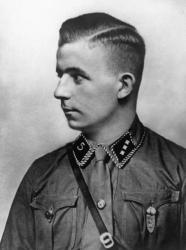
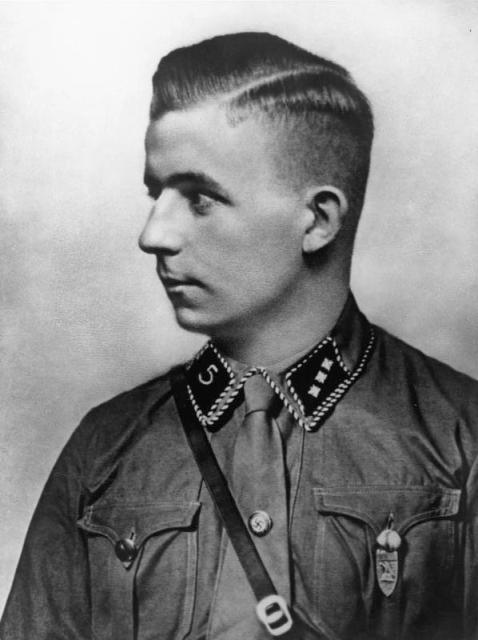
Horst Wessel was a young leader in the Nazi Party’s paramilitary SA whose short life acquired a much larger meaning through propaganda. He helped organize Nazi activity in Berlin’s working-class districts and wrote the lyrics later associated with the Horst Wessel Song. After he was fatally shot in 1930, Joseph Goebbels and the Nazi Party transformed him into a political martyr, shaping a legend that often obscured the violence and uncertainty surrounding his life and death.
Family and Education
Wessel was born on October 9, 1907, in Bielefeld, Germany, the son of a Protestant pastor. His family moved to Berlin in 1913. He attended the Luisenstädtisches Gymnasium and began studying law at the University of Berlin in 1926.
As a teenager, he entered right-wing nationalist organizations, including the Bismarck League and the extremist Wiking League. After the latter was banned, he joined the Nazi Party and its paramilitary organization, the Sturmabteilung, or SA, in 1926. His political involvement soon eclipsed his academic studies.
SA Organizer in Berlin
Wessel initially worked on Nazi recruitment and helped organize groups of the Hitler Youth. In 1928, he abandoned his law studies and devoted himself to SA activity, supporting himself with temporary jobs. By 1929, he led an SA unit in Friedrichshain, a working-class district of Berlin where Nazi and Communist organizations competed for influence and street clashes were frequent.
Wessel was an energetic speaker and organizer, and became one of the more visible Nazi agitators in Berlin. His political work was rooted in the SA’s confrontational strategy: building support through rallies, recruitment, and intimidation in neighborhoods where working-class voters were also courted by the Communist Party.
The Song and Its Political Use
In 1929, Wessel wrote the lyrics of a marching song beginning “Die Fahne hoch,” set to a melody already familiar in Germany. Published in the Nazi newspaper Der Angriff, the song became known as the Horst Wessel Song. Its text celebrated the SA and Nazi movement, reflecting the movement’s glorification of political violence and self-sacrifice.
The song became more famous after Wessel’s death than he had been in life. In 1930 it was adopted as the Nazi Party anthem. After Adolf Hitler came to power in 1933, it was used alongside the first stanza of Deutschlandlied at official occasions, effectively functioning as a second national anthem. It was banned in both East and West Germany after 1945.
Death and the Making of a Martyr
On January 14, 1930, Wessel was shot in his Berlin apartment and seriously wounded. He died in hospital on February 23, aged 22. The precise circumstances and motive have been disputed. The attack involved Albrecht Höhler, a member of the Communist-affiliated Red Front Fighters’ League, but historians note that personal conflict and political hostility both formed part of the context.
Goebbels moved quickly to present Wessel’s death as a sacrifice for the Nazi cause. His funeral became a political event, and the party cast him as a martyr. Nazi films, books, ceremonies, and youth literature further developed the story, turning a young SA organizer into a symbol intended to inspire loyalty and continued violence. The legend served political purposes and should be distinguished from the more complicated historical record.
Legacy
Wessel’s importance lies less in the length of his career than in the way the Nazi movement used his image. His song became a ritual of the regime, while his death was invoked to justify attacks against political opponents. The transformation of his life into propaganda offers a clear example of how authoritarian movements build myths around their own members, recasting violent actors as heroes and using their stories to mobilize supporters.