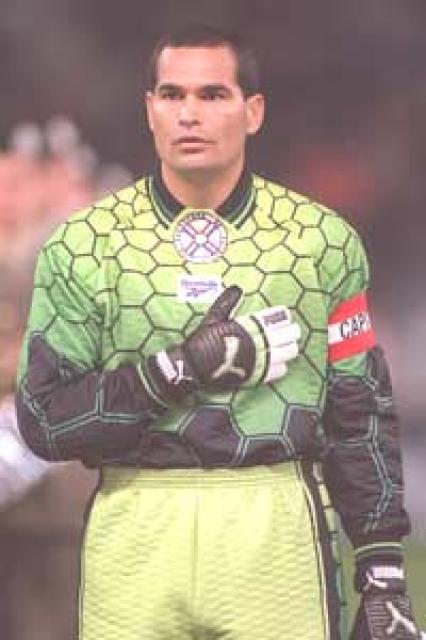
Hose Luis Chilavert
 Paraguay
- Biography of Jose Luis Felix Chilavert Gonzalez
- Early Life
- Football Career
- Club Career
- International Career
- Awards and Achievements
- Personal Life
- Legacy
Biography of Jose Luis Felix Chilavert Gonzalez
IntroductionJose Luis Felix Chilavert Gonzalez is a renowned Paraguayan football goalkeeper. His goal-scoring ability is as impressive as that of the most prolific strikers. He has scored over fifty goals in matches of various levels, setting several personal records that are unlikely to be broken anytime soon. Chilavert, the goalkeeper of the Paraguayan national team, has transitioned from being an outstanding player to a national icon, loved and hated by the people.
Early Life
Jose Luis Chilavert was born on July 27, 1965, in the city of Luque, located eight kilometers from the Paraguayan capital Asuncion. His father Catalino worked as an accountant in a state enterprise, striving to provide a decent living for his wife and four children. In those days, even a black-and-white television was considered a technological marvel; its viewing became a celebration for the entire family, and football broadcasts were particularly popular.
Football Career
Chilavert's passion for football was evident from a young age, and he dreamed of playing in front of cheering crowds in stadiums. However, whenever he played with his friends, they always made him the goalkeeper because of his smaller stature compared to his peers. At the age of 14, Chilavert joined the club "Sportivo Luqueno," where his three older brothers, Julio Cesar, Juan, and Rolando, also played. The coach asked Chilavert which position he had played before, and after some thought, he chose to become a goalkeeper, determining his future. Little did anyone know that the slim, short boy would become a fearsome goalkeeper, striking fear into his opponents with just his presence.
Chilavert made his debut for "Sportivo Luqueno" in 1980 at the age of 15. However, due to his young age and studies, he did not regularly play for the team. Chilavert almost quit football due to his parallel education at the university, where he studied economics. The burden of studying tired him to the point where he would fall asleep during lectures. However, his love for football prevailed, and at the age of 18, he secured a permanent position as the goalkeeper of "Sportivo Luqueno." He vividly remembers his debut in the national championship: "I still remember that evening when we defeated 'Sol de America' with a score of 3-1, and I continue to thank my then coach Pedro Fernandez, who decided to put an inexperienced boy in goal. My whole family came to watch that match, but what I remember most are the words of my grandfather, who said that a great future awaited me, and he would definitely witness that moment. Unfortunately, he only saw my debut as he passed away the same week."
Club Career
The following year, Chilavert moved to "Guarani," where he won the championship title and became one of the key players in the victorious campaign. His performance caught the attention of Gaetano Re, the coach of the national team, who later led them in the 1986 World Cup. From "Guarani," Chilavert moved to Argentina to play for "San Lorenzo," coached by Velibor (Bora) Milutinovic, the current head coach of the Honduras national team. It was there, under the guidance of the Yugoslav specialist, that he learned to take free kicks, often engaging in friendly competitions with his mentor. According to Milutinovic, Chilavert always won those duels because he could shoot with both feet, while Chila could only use his left foot. Nevertheless, the Paraguayan goalkeeper made such progress in executing free kicks that he could break a glass Coca-Cola bottle during training. Chilavert believes that there is no secret to his free-kick success: "There are two components to success - hard work and practice. By the way, God blessed me with tall height and only a size 39 foot. But thanks to the smaller surface area in contact with the ball, I can strike more accurately. Besides, I never use any braces to maintain sensitivity in my foot." Currently, he scores at least 8 out of 10 free kicks during training, with 1 or 2 hitting the post or crossbar.
Chilavert's talent for free kicks was not utilized for a long time. However, in August 1989, he finally opened his goal-scoring account in official matches, stunning the Colombian national team's goalkeeper Rene Higuita, whom he considered one of his idols. With the score at 1-1, he crossed the entire field, approached the ball, and scored a penalty kick on the 90th minute, securing victory for the national team.
After playing for "San Lorenzo," Chilavert moved to Spain, joining "Real Zaragoza" in 1988. However, his time in Spain did not go well. He then moved back to Argentina and joined "Velez Sarsfield," where he spent ten unforgettable years. During this decade, Chilavert experienced both love and hate from the fans, not only in Argentina but also in other South American countries. Colombian club fans spat and whistled at him when "Velez Sarsfield" traveled to Colombia for Copa Libertadores matches, while fans of "River Plate" and "Boca Juniors" would have gladly thrown grenades at him but had to settle for a few accurate firecracker hits.
Playing for "Velez," Chilavert achieved great success, winning the Argentine championship three times, the Copa Libertadores, and the Intercontinental Cup. His time at "Velez" was not only the best in his career but also a period of self-affirmation. Chilavert became a leader for both "Velez Sarsfield" and the Paraguayan national team, captaining both teams. It was his confident play on the last line of defense that allowed "Velez" to win multiple championships and achieve glory in international competitions. Chilavert became not only an outstanding player but also a national hero, loved and respected by the Paraguayan people.
International Career
Chilavert's achievements were not limited to his club career. He also had a stellar international career, representing the Paraguayan national team. He played a crucial role in helping Paraguay reach the knockout stages of the 1998 FIFA World Cup in France. Paraguay was placed in Group D, alongside Spain, Nigeria, and Bulgaria. Despite being considered underdogs, Paraguay drew with Bulgaria, held off the attacking Spanish team, and secured a 3-1 victory against Nigeria, managed by his former coach Bora Milutinovic. Chilavert's performance was instrumental in Paraguay's success in the tournament.
Awards and Achievements
Jose Luis Chilavert's outstanding skills and contributions to the sport have garnered him numerous awards and accolades throughout his career. Some of his notable achievements include:
- Best Goalkeeper in the World: 1995, 1997, 1998, 1999
- South American Footballer of the Year: 1996
- Argentine Footballer of the Year: 1996, 1999
- Best Footballer in the World: 1996
- Best Goalkeeper in the 1998 FIFA World Cup
- Ranked 6th among all goalkeepers of the 20th century and 2nd among South American goalkeepers of the 20th century
Personal Life
Outside of football, Chilavert led a vibrant life, always being in the spotlight and balancing between love and hate, applause, and whistles. He has been married to Marcela, an English teacher with blonde hair and blue eyes, for 14 years. The shy Paraguayan spent weeks admiring Marcela's beauty while she played tennis on the sports complex courts before finally proposing to her. They have been inseparable ever since.
Chilavert has often clashed with journalists, who relentlessly pursued him for scandalous headlines. He has physically confronted reporters on several occasions, forcing them to flee. The Argentine media has made repeated attempts to pry into Chilavert's personal life, but they always hit a dead end. During his time at "Velez Sarsfield," even the club's president Raul Gamez did not know Chilavert's mobile phone number, registered under a different name. Despite his public persona, Chilavert guarded his privacy fiercely. However, beyond the football field, Chilavert lived a fulfilling life, always in the limelight and balancing on the thin line that separates good from bad, love from hate, and cheers from jeers.
Legacy
Jose Luis Chilavert remains an enigma to many. The only thing that is evident is that he is a bundle of contradictions. He admires Daniel Passarella but despises coaching dictatorship. He acknowledges Diego Maradona as the greatest footballer of all time, yet calls him the "first addict of Argentina." He considers himself a staunch anti-communist but preaches about a society of "equality and brotherhood" and believes in the necessity of a "strong hand." He opposes abortion but sees it as necessary in cases of rape. He collects cold and firearms but does not know how to use them.
Chilavert's fearlessness and lack of loyalty to those in power have made him a target for criticism. His outspoken nature led to an assassination attempt at the Ezeiza airport near Buenos Aires. While unarmed, the Bulldog fended off seven unknown assailants trying to stab him. Perhaps that incident is what prompted him to keep a baseball bat on the backseat of his car, always ready to defend himself.
Does the fearless Chilavert fear anything? At least two things bring him close to panic - flying and the sea. Air travel causes severe headaches for him, and being on the water is unpleasant because he cannot swim. However, one should not think that while playing in Argentina, Chilavert only chased journalists and defended the Paraguayan people, whom he considered "cowardly." Above all, he played football, and during his time in Argentina, he won three national championships, scored a hat-trick in a match, and achieved numerous individual and team accolades.
Jose Luis Chilavert's impact on football is undeniable. He revolutionized the role of a goalkeeper, showing that they can be leaders on and off the field. His success in both club and international competitions, along with his unique ability to score goals, cemented his legacy as one of the greatest goalkeepers in the history of the sport.


