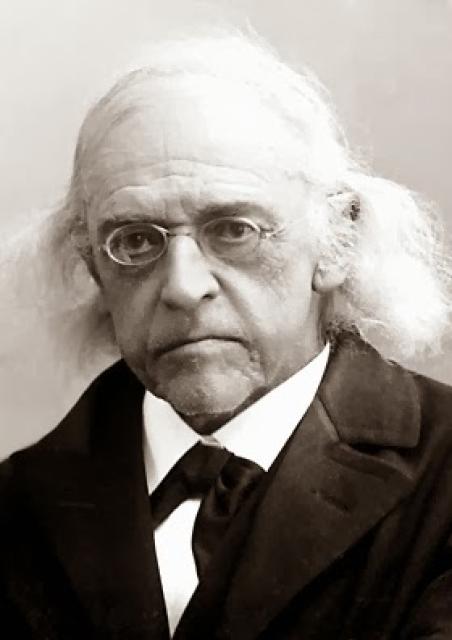
Hristian Matias Teodor Mommzen
 Germany
- Theodor Mommsen: German Historian and Nobel Laureate
- Italian Research and "Corpus Inscriptionum Latinarum"
- Political Activism and "Schleswig-Holsteinische Zeitung"
- The "Römische Geschichte" (Roman History)
- Later Years and Political Career
- Nobel Prize and Legacy
Theodor Mommsen: German Historian and Nobel Laureate
Early Life and EducationChristian Matthias Theodor Mommsen was born on November 30, 1817, in the village of Garding, Duchy of Schleswig, then under Danish rule. At the age of four, his family moved to Oldesloe, Duchy of Holstein, also under Danish control. Mommsen's father, Jens Mommsen, a Protestant pastor of modest means, instilled in his son a love of literature, introducing him to German poetry and helping him translate Hugo, Byron, and Shakespeare into German.
At the Christian Gymnasium in Altona, Mommsen received a brilliant education in classical languages, philosophy, rhetoric, and German literature. In 1838, he enrolled at the University of Kiel to study jurisprudence, specializing in Roman law. There, Professor Otto Jahn introduced Mommsen to the study and interpretation of ancient inscriptions.
Italian Research and "Corpus Inscriptionum Latinarum"
During his university years, Mommsen published a collection of poems co-authored with his brother, Tycho, and their friend, Theodor Storm. His dissertation, "De collegiis et sodaliciis Romanorum" (On the Colleges and Corporations of the Romans), earned him the support of the University of Kiel, which petitioned the Danish government for a three-year scholarship to Italy.
In Italy, Mommsen wrote numerous articles and began collecting material for his groundbreaking work, "Corpus Inscriptionum Latinarum" (Collection of Latin Inscriptions), a voluminous collection of Latin inscriptions published in 16 volumes from 1863 to 1936. The first volume was dedicated to Count Bartolomeo Borghesi, an Italian politician and scholar who initially supported Mommsen's research.
Political Activism and "Schleswig-Holsteinische Zeitung"
Upon returning to Schleswig in 1847, Mommsen became involved in the democratic movement seeking to free the German-speaking duchies north of the Elbe from Danish rule. During the 1848 Revolution, he edited the liberal newspaper "Schleswig-Holsteinische Zeitung." However, he resigned at the end of the year to become a professor of civil law at Leipzig University.
Mommsen participated in the Saxon Uprising in the same year, resulting in the loss of his chair. In 1852, he moved to Zurich, where he began to write his monumental work on Roman history, combining scholarly rigor with a broad accessibility for general readers.
The "Römische Geschichte" (Roman History)
The first volume of "Römische Geschichte" (Roman History) was published in 1854, the year Mommsen returned to Germany as a professor at the University of Breslau in Prussia. The same year, he married Maria Reimer, the daughter of a bookseller, and they had sixteen children.
The first three volumes of "Roman History" (the second and third volumes published in 1855 and 1856) covered Roman history from its foundation to 46 BCE, when Julius Caesar defeated the armies of the Senate in North Africa. Written with exceptional clarity and erudition, the work brought Mommsen international acclaim.
To enhance its vividness, Mommsen often compared Roman statesmen with 19th-century politicians. While some of his findings have been revised in light of later research, "Roman History" remains a notable contribution to both history and literature. Mommsen planned a fourth volume on the Roman emperors, but this was never realized as he recognized its potential inferiority to the first three. His "Die Provinzen, von Caesar bis Diocletian" (The Provinces, from Caesar to Diocletian), covering the first three centuries of Roman provincial history, was published in 1885 as Volume V of "Roman History."
Later Years and Political Career
In 1858, Mommsen became professor of Roman history at the University of Berlin, where he lived for the rest of his life. Elected a member of the Prussian Academy of Sciences, he received support for his continued work on the "Corpus Inscriptionum." Mommsen remained politically active throughout his later years. He served in the Prussian parliament from 1863 to 1866 and 1873 to 1879, representing the Progressive Party.
After Bismarck unified the independent German states into the German Empire, Mommsen became a member of the Reichstag, where he opposed Bismarck's domestic policies and anti-Semitism prevalent in the university world. From 1871 to 1888, he published a three-volume study, "Römisches Staatsrecht" (Roman Constitutional Law), codifying the legal system underlying the Roman constitution and analyzing it within the context of Roman history. "Römisches Strafrecht" (Roman Criminal Law) followed in 1899.
Nobel Prize and Legacy
In 1902, Leo Tolstoy was considered the frontrunner for the Nobel Prize in Literature. However, his views proved unacceptable to the Nobel Committee, leading to an expansion of the award's criteria to include historical works. As a result, the prize was awarded to Mommsen, "one of the greatest historical writers, through whose monumental work, 'Römische Geschichte,' a living picture of the ancient world has been presented before our eyes."
In his acceptance speech, Swedish Academy member S.D. Wirsén praised not only Mommsen's vast knowledge but also his brilliant writing style. The 85-year-old historian did not deliver a Nobel Lecture. Mommsen died on November 1, 1903, in Charlottenburg, near Berlin.
A slender man with a keen face and piercing eyes, Mommsen was a renowned lecturer. His research was aided by numerous students, whom he in turn supported. Historians James Thompson and Bernard Holm, co-authors of "The Oxford History of Historical Writing," described Mommsen as "the wonder of German science." According to British historian Francis J. Haverfield, Mommsen was at once "a poet, a lawyer, a critic, and an artist—impressionable, enthusiastic, gifted with imagination."