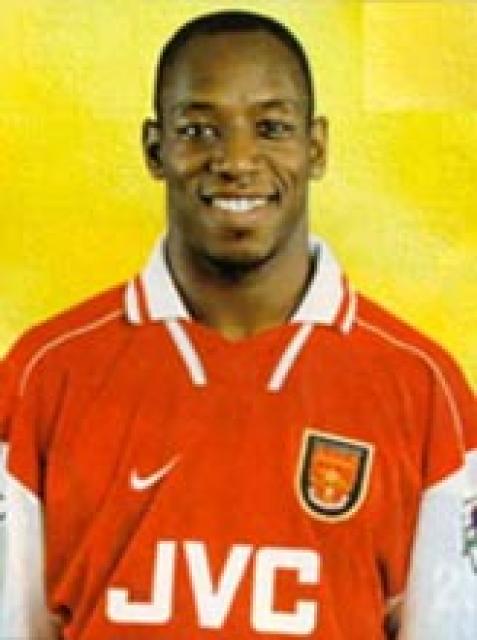
Ian Rayt
 Great Britain
Biography of Ian Wright
Ian Wright, an English footballer, holds an esteemed place in Arsenal's Hall of Fame, but there is still debate about his contribution to the team's success in the Premier League. Born on November 3, 1963, in Woolwich, London, England, Wright played as a forward throughout his career.
Career
1. Crystal Palace (Crystal Palace London, England) 1985-1991
- English League: 225 matches, 89 goals
- English League Cup: 19/9
- FA Cup: 12/3
- Other games: 22/16
- Total: 278/117
- Scoring rate: 42.1%
Achievements:
- FA Cup finalist - 1990
- Winner of the Zenith Data Systems Cup - 1991 (Crystal Palace - Everton 4-1; Wright scored two goals)
2. Arsenal FC (Arsenal FC London, England) 1991-1998
- Transfer fee: £2,500,000
- Unofficial debut: Leicester City - Arsenal 1-1 (goal by Wright), Rumbelows Cup, September 1991
- Official debut: Southampton - Arsenal 0-4 (Wright hat-trick), English League, September 28, 1991
- Last match: Aston Villa - Arsenal 1-0, English League, May 10, 1998
- Total for Arsenal:
- English League: 219 matches, 128 goals, scoring rate 58.4%
- English League Cup: 29 matches, 29 goals, scoring rate 100%
- FA Cup: 16 matches, 12 goals, scoring rate 75%
- European cups: 21 matches, 16 goals, scoring rate 76.2%
- Total: 288 matches, 185 goals, scoring rate 64.2%
Titles:
- English League champion - 1997/98
- FA Cup winner - 1992/93, 1997/98
- English League Cup winner - 1992/93
- FA Charity Shield winner - 1993
- UEFA Cup Winners' Cup winner - 1993/94
- Top scorer in the English League - 1991/92, 1992/93
- Winner of the Golden Boot - 1992
- Arsenal's top scorer - 1991/92, 1992/93, 1993/94, 1994/95, 1995/96, 1996/97
- Arsenal's all-time top scorer
- Honorary member of the Marble Hall of Fame at Highbury
- Member of the Order of the British Empire
3. West Ham United (West Ham United London, England) 1998/99
- Transfer fee: £750,000
Achievements:
- Top scorer of the club in the 1998/99 season
4. Nottingham Forest (Nottingham Forest, England) 1999 (on loan, 1st division)
5. Celtic FC (Celtic FC Glasgow, Scotland) 1999 (Scottish Premier League, on loan)
6. Burnley (Burnley, England) 1999/00 (2nd division)
International career:
- Played 31 matches for the England national team, scored 7 goals
As of April 27, 2002, Ian Wright is no longer playing. This sign could hang on the door of the Premier League headquarters. The outstanding English footballer Ian Wright announced his retirement. He realized that the old Wright was no longer there. To be a pale shadow of the great Wright, evoking sympathy from the audience, was not for him. He left as the legendary Wright, not a decrepit ruin. Together with Wright, that good English football of the early 90s began: the English football that we fell in love with a few years ago when we watched "On the Way to Wembley" at night. The football was somewhat naive but very attractive. You only needed to see it once to remember it for a lifetime. Wright's game was art. Ian was the greatest improviser. When he received the ball, defenders had their heads spinning. They didn't know what trick Ian would do next. Would he dribble or pass the ball?
The most interesting thing is that Ian himself didn't know what he would do. Thoughts and plans came to his bald head on the go. Playing against Ian was a real punishment, both for defenders and goalkeepers. With his movements, short sprints, and jumps, Ian exhausted defenders. And a strong, powerful shot with both feet was extremely uncomfortable for any goalkeeper. Wright often scored goals without even taking a swing. On the field, he was aggressive and uncontrollable, restless and irritable. He dodged defenders, and his celebrations after scoring goals infuriated opponents. His behavior didn't quite correspond to his age. Many hate Ian Wright for these reasons, but at the same time, millions adore him for the same. Ian was born in Woolwich, a district of London, and was an Arsenal fan from childhood. Naturally, he wanted to play for the Gunners. And that's what happened in the end.
But before that, there were great seasons at Crystal Palace and offers from several Premier League clubs that Wright rejected. If he was going to play, it would be for Arsenal. And so it happened. Ian waited for Arsenal's invitation and soon became an integral symbol of the club. Fate seemed to have influenced his past. The culmination of his first season at Arsenal was an incredible home match against Southampton. On May 2, 1992, Wright needed to score two more goals than Gary Lineker of Tottenham to win the Golden Boot. Before halftime, Lineker scored a goal, but Wright's goal was disallowed due to a controversial decision by the referee. However, Ian didn't give up, converted a penalty, and scored a beautiful goal in the 89th minute. The clock was ticking down when he received the ball in the penalty area. He remembers: "I wanted to shoot past the goalkeeper, but the ball hit my shin and went into the goal. Then I thought that I was destined to win." And then there were six more fantastic seasons at Arsenal, each of which saw Wright demonstrate phenomenal scoring abilities. In his seven seasons with the Gunners, Ian became the club's top scorer for six consecutive years! Only in the 1997/98 season did he relinquish the top spot to Dennis Bergkamp (due to an old injury that prevented him from playing more than a third of the season). Wright needed only seven years to set an astonishing record for Arsenal. In 288 matches, he scored 185 goals, becoming the club's all-time top scorer! Amy Lawrence, in her work "Proud to say that name," rightly suggests that Arsenal's relationship with Wright's volatile character was mutually beneficial. "Ian's skill and energy undoubtedly benefited Arsenal, which, in turn, provided the player with stability and support during the many troubles he faced. And when Ian felt that the whole world was against him, the club was always ready to pat him on the back and say 'well done.'" However, Wright's phenomenal career at Arsenal eventually came to an end.
No sooner had they celebrated the long-awaited double at Highbury than news agencies spread the word. Wright was sold to West Ham for a small sum by English standards, £750,000. On his farewell to his beloved club, Ian said, "I feel like I'm staying with Arsenal. I feel part of Arsenal, like Tony Adams. I'm absolutely in love with this club. Because I was born in Woolwich, the home of Arsenal, they say playing for Arsenal is my destiny." At a press conference held for his arrival at Upton Park, Wright shared his feelings: "I signed a two-year contract, but I would like to play for the club even longer if I continue to meet the level. I told my agent that I would stay at Arsenal if it didn't work out with West Ham. The emblem of West Ham was on my first school bag bought by my mom," Wright revealed.
Ian's debut for West Ham took place at Hillsborough, with incredible support from the away fans. And the fact that he scored a goal against Sheffield Wednesday guaranteed him an extended "honeymoon" period that all newcomers dream of. When Harry Redknapp was asked if fate played a role in signing Ian Wright, the coach laughed. But when talking about the player, he was extremely serious: "He's just a fantastic striker. It was a great signing. I've never seen players with such enthusiasm before: he has a very lively character and has a huge impact on and off the field." And Wright's influence beyond the football field cannot be overstated. As he himself claims, "The guys gave me a fantastic reception. They work for me, and I work for them, and if I can justify Harry's trust by scoring goals, I'll be happy." Money from Peter Storrie bought more than just that. Of course, Wright was an excellent striker. But he was also an example to follow.
The late start to his career - he made a name for himself at Crystal Palace at the age of 21 - endowed him with an insatiable hunger for the game. For young West Ham players like Rio Ferdinand, Frank Lampard, and Joe Cole, his exemplary athleticism, agility, and vitality were beneficial. "Ian behaves like a youngster in the dressing room," agrees Redknapp. "He is joyful and full of energy. Last year, I trained very young and very quiet guys. They just sat silently, not saying a word. But before the Wednesday game, they were all shouting - Wright was in his element." When asked if fate played a role in signing Ian Wright, John Helm, the club historian, says, "In the past, West Ham wouldn't have taken on someone like Wright. Of course, the club had temperamental players, like Keith Robson and Julian Dicks, as well as 'elderly' players by football standards (Helm gives the example of Jimmy Greaves: 'He was 30 when he played for West Ham. He spent 2 seasons here and still, despite similar scoring rates to Wright, had a completely different character'), but never before had age and inconsistency been combined in one player as they were with Wright." Nevertheless, Helm's verdict is encouraging: "Buying any player is a risk, but Ian enjoys constant popularity as a cult figure, despite the high likelihood of missing matches due to injuries and suspensions. But if he scores about 15 goals, he can lift the team out of mid-table." John Helm's prediction almost came true. Out of 38 matches in the 1998/99 season, Ian participated in 20 (+3 substitute appearances) and became West Ham's top scorer with 9 goals.
Wright was born to score goals and earn bookings. In that season, he received 9 yellow and 1 red card. So, there was a balance between triumphs and penalties. And it will probably continue as long as Wright keeps playing. West Ham paid Wright £18,000 per week (approximately $29,000) and was not averse to continuing to work with Ian. However, then an offer came from Nottingham Forest, managed by Wright's former Arsenal teammate David Platt. Both sides agreed, and Ian went on loan to Nottingham. In his debut match for the new team, Wright managed to score, and in the subsequent games, he scored four more goals. But suddenly, a new opportunity arose - Celtic announced the acquisition (on loan until the end of the 1999/00 season) of the aging but still great Wright. So Ian left the English Premier League and moved to the Scottish one. And once again, he had a successful debut. In his first four games for the new team, Wright scored twice. However, his loan season at Celtic ended, and Ian had to find a new haven. He realized that he was no longer able to compete in the top divisions of the UK and moved to the modest second division team Burnley. Perhaps it is there that one of England's greatest forwards will end his playing career. The only thing Wright might be unsatisfied with is his international career. After all, he remained purely an English footballer. He played for the national team, with thirty matches being quite decent.
But all thirty were qualifiers and friendlies. Wright never appeared in major international competitions for various reasons. Only the crucial game against Italy for a spot in the 1998 World Cup comes to mind - in the final minutes, Wright found himself one-on-one, beat the goalkeeper, and, I quote, "hit the post!" He was unlucky. There was a chance to go to the French World Cup, but in Morocco, Wright suffered an Achilles tendon injury. Later, Glenn Hoddle confirmed that he would have taken Ian to the national team, but the fiery forward surprisingly took it calmly. "I was surprised at how easily he took it," Hoddle recalled in his book. "He said, 'It's not meant to be.' " Wright didn't have time to take care of himself, to treat the injury. He was eager for battle, and everything else was put on hold. It's sad. They leave quietly, without pomp. John Barnes, Mark Wright, Neville Southall, Dalian Atkinson, David Platt, Ian Rush, Steve Bruce, Alan Smith, Paul Parker. All those who taught us to love English football. Those who brought England closer to us. And now Ian Wright has left. He intends to start a new life and become an actor. Let's wait for Wright's return to the screens. He was a great actor on the field, being a great footballer. Let him become a great actor. The 1991/92 season ended with Arsenal dramatically demolishing Southampton 5-1. The demonic Wright tormented the "Saints," scoring a hat-trick and also winning the Golden Boot. Each of his goals is stamped with true quality - even the confidently taken penalty that allowed him to overtake Lee Dixon. Towards the end of the match, Wright raised the tempo to impossible levels, simply terrorizing the defenders. He received the ball from David Seaman on his own half and, I quote, "ran, ran, and ran." Controlling the ball superbly, he approached the opponent's penalty area. When another "Saint" rushed towards him, Wright slowed down and sent the ball into Tim Flowers' goal. The goal demonstrated Wright's individual brilliance - he showed extraordinary composure.
All of this is what made him a legend. His joy after scoring a goal is easily explained, but he needed one more goal. The thirst for competition is what always set Ian apart from the rest. Time added by the referee is running out, and, strangely enough, a randomly cleared ball finds Alan Smith. Alan wrestles with Richard Hall and approaches the penalty area. Kevin Campbell intervenes in the struggle, and the ball bounces to the forgotten Wright, beyond the reach of the defenders. One-on-one, ten yards from the goalkeeper - and Ian's luck helps him become the winner (the ball bounced off his shin). But if it hadn't been for the referee's added time, the match could have ended in a draw. So, Wright's last-minute goal secured Arsenal's victory. It wasn't just a victory but a triumph that crowned Wright's remarkable season. The elation of the occasion was palpable as the fans chanted his name. In the end, it was a fitting end to an incredible season for a true Arsenal legend.