Ignatius Pecherskiy
- Archimandrite Ignatius of the Kyiv-Pechersk Monastery
- Archimandrite
- Spiritual Gifts and Miracles
- Death and Relics
- Local Veneration
- Official Recognition
- Iconography
Archimandrite Ignatius of the Kyiv-Pechersk Monastery
Early Life and MonasticismThe name of Archimandrite Ignatius appears in the oldest known memorial book of the Kyiv-Pechersk Monastery, dating back to the late 15th or early 16th century. Little is known about his early life or the circumstances that led him to the monastery.
Archimandrite
Ignatius became Archimandrite of the Kyiv-Pechersk Monastery, a position of great authority and responsibility. His tenure as Archimandrite ended sometime before 1434, when his successor, Archimandrite Nikifor I, is mentioned in a manuscript.
Spiritual Gifts and Miracles
According to a 17th-century inscription transcribed from his tombstone, Archimandrite Ignatius possessed the gift of miraculous healing. His prayers are said to have cured the sick and his communion bread brought about miraculous recoveries.
Death and Relics
The exact date of Archimandrite Ignatius's death is unknown, but it is believed to have occurred before 1434. His relics were interred in the Far (Feodosiev) Caves of the Kyiv-Pechersk Lavra.
Local Veneration
Local veneration of Archimandrite Ignatius began in the late 17th century, when Archimandrite Varlaam (Yasynsky) of the Kyiv-Pechersk Monastery established the feast day of the Venerable Fathers of the Far Caves.
Official Recognition
In the second half of the 18th century, the Holy Synod granted permission for the inclusion of several Kyiv saints, including Archimandrite Ignatius, in the official church calendar. A troparion and kontakion were composed in his honor in the 17th century, and his feast day of December 20 was established in the late 19th century.
Iconography
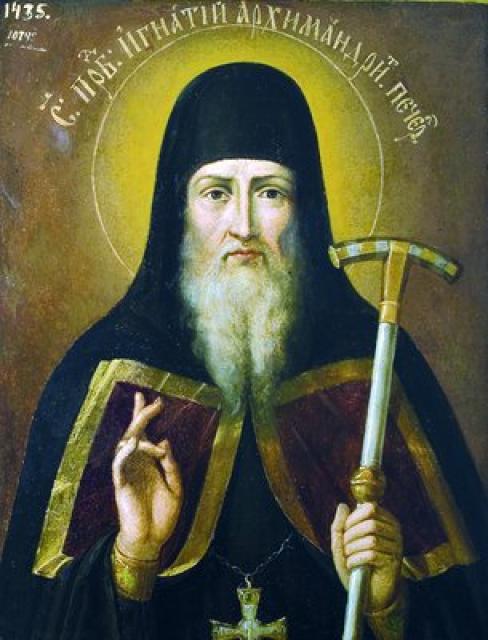
An iconographic guide from the late 18th century provides a description of Archimandrite Ignatius's iconography: gray beard in the style of St. Sergius, hair flowing over his ears, wearing a bishop's cap, a red priestly vestment with a green undergarment, a golden stole visible beneath his robe, and holding a Gospel book pressed to his heart.