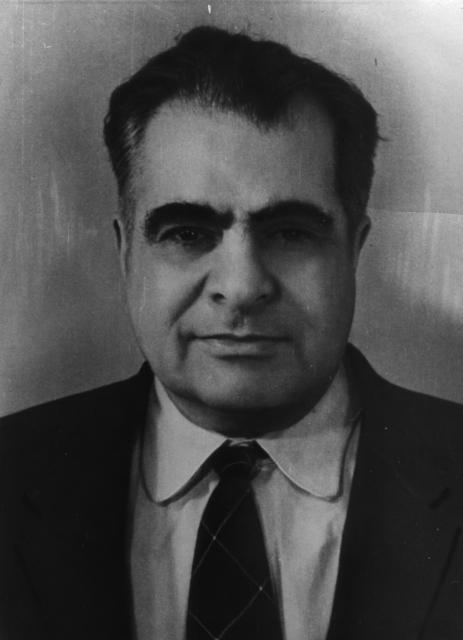
Ilya Dzhigit
- Ilya Semenovich Dzhigiti - A Pioneer in Soviet Radioelectronics
- Academic Career and Research
- Contributions to Television
- Military Radioelectronics
- International Collaboration
- Awards and Recognition
- Personal Life and Legacy
Ilya Semenovich Dzhigiti - A Pioneer in Soviet Radioelectronics
Early Life and EducationIlya Semenovich Dzhigiti was born in Moscow in 1889 to a Crimean Karaite family. His father, Semyon Ilyich Dzhigiti, was an accountant at a tobacco factory, and his mother, Emilia Borisovna Dzhigiti, was a homemaker. Ilya had two sisters, Anna and Tamara.
Dzhigiti graduated from high school in 1919. After a brief period of employment, he volunteered for the Red Army in 1920 and was assigned to the Military Aerial Survey and Photogrammetric School of the Red Air Force. Upon graduation as a military aerial surveyor, he served in the Red Army's Air Force Division until his demobilization in 1921.
Academic Career and Research
Dzhigiti then enrolled in the Faculty of Physics and Mathematics at the 1st Moscow State University, graduating in 1926. He continued his studies as an associate researcher and received his doctorate in 1929.
From 1924, Dzhigiti worked at the Laboratory of the Scientific Research Institute of Physics and Crystallography, where he collaborated with P.G. Tagger and A.A. Shishov on sound film technology. In 1928, they demonstrated the first sound film recordings in the Soviet Union.
Dzhigiti also conducted extensive research on light modulation, sound recording, and reproduction on film. After joining the All-Union Electrotechnical Institute, he designed and developed a sound film system with Tagger and Shishov. This system was used to record the first full-length Soviet sound films, including "Putyevka v zhizn" ("Ticket to Life") and "Mekhanichesky predatel" ("Mechanical Traitor").
Contributions to Television
Dzhigiti was one of the pioneers of Soviet television. With V.N. Arkhangelsky, he designed and installed the first mechanical television transmitter, which was regularly used in the People's Commissariat of Communications' television workshop from 1934 to 1941.
Dzhigiti also designed the first large-scale television screen, measuring 1 square meter. It was exhibited at the Invention Exhibition at the Polytechnic Museum in Moscow in 1935.
Military Radioelectronics
In 1935, Dzhigiti was transferred to the State Institute of Telemechanics and Communication, where he headed the laboratory and focused on electronic television. He continued his work in defense institutes, developing military radio technology.
In 1943, Dzhigiti was appointed Deputy Head of the Scientific Department of the Council for Radiolocation under the State Defense Committee. He worked closely with Academician A.I. Berg and was effectively his deputy.
International Collaboration
Dzhigiti made several official visits abroad, including to the United States in 1936, 1938, and 1945, and to England in 1938, 1942, and 1946. He studied television technology, inspected radiolocation stations, and worked with American colleagues in the procurement of radio equipment.
Awards and Recognition
Dzhigiti received numerous awards for his contributions, including the Order of Lenin (1954) and the Order of the Badge of Honor (1953), as well as three medals. He was also a highly respected and influential figure in the Soviet radio electronics community.
Personal Life and Legacy
Dzhigiti married Olga Vladimirovna in 1933. They had a daughter, Elena, who became a scientific editor.
Dzhigiti passed away suddenly from a myocardial infarction at the age of 62 and was buried in Moscow. He is remembered as a brilliant scientist, a dedicated mentor, and an exemplary human being who made significant contributions to the development of radioelectronics in the Soviet Union.



