Iogann Overbek
 Italy
ItalyBiography of Johann Overbeck
Johann Overbeck was a German artist who played a significant role in the development of art in the second half of the 19th century. During this period, a new stage in artistic development usually began with a small group of artists coming together to oppose the official academy and seek new possibilities in art. Examples of such groups are the Pre-Raphaelites in England, the Impressionists in France, and the Wanderers in Russia. However, this phenomenon first occurred at the beginning of the century when six German painters, who had studied in Vienna - F. Overbeck, F. Pforr, Wintergerst, I. Zutter, G.L. Vogel, and G.L. Hottinger - dissatisfied with the academic system, formed an association called the "Saint Luke Union". From the very beginning, Friedrich Overbeck played the role of the leader of this artistic "brotherhood".
Their protest against academic art, which they considered unoriginal and based on eclectic assimilation and imitation of established models, was prepared by the development of romantic aesthetics and the ideas of W.G. Wackenroder, L. Tieck, and F. Schlegel. Romantic aesthetics "historicized" the ideal of art and recognized it not as a timeless norm, but as a product of a specific era and its moral, social, and religious values.
Overbeck and his followers believed it was necessary to connect with the old masters in spirit, to "reincarnate" in them and in some way repeat their spiritual and life experience. For this purpose, they formed the "Saint Luke Union", modeled after the ancient guilds under the patronage of this saint. In 1810, the artists moved to Rome, where they were interested in the city as the homeland and center of Christian art, rather than its antiquity. They settled in the cells of the abandoned monastery of San Isidoro. After a few years, Overbeck - and others who followed - converted to Catholicism. In Rome, they became known as the "Nazarenes" due to their religiousness and the way they wore long hair, divided in the middle. Living a secluded life in the monastery, the Nazarenes elevated their artistic service to the level of spiritual service. This new mission of painting was the subject of their evening discussions and often served as the theme of their works.
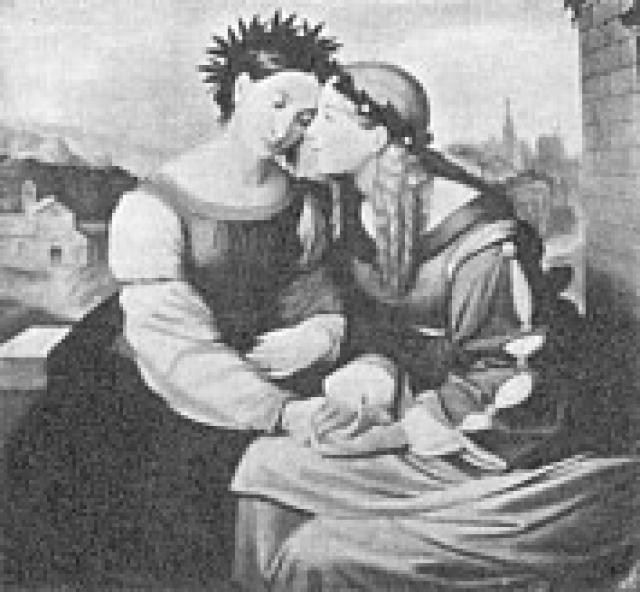
One of the motifs developed in the drawings of Overbeck and Pforr was a composition in which Raphael and Dürer were portrayed as saints at the throne of Art. The friendship between these two artists, Pforr and Overbeck, became symbolic. This friendship and the idea of uniting the Italian and German principles were the focus of Franz Pforr's symbolic diptych painting "Shulamith and Maria". Overbeck later expressed the same idea in a simpler and clearer way in his famous painting "Germany and Italy". He depicted these countries as two girls - one with a laurel wreath and a face reminiscent of Raphael's Madonna, and the other with a wreath of bindweed, golden hair, and a costume from Dürer's era - gently leaning towards each other. Overbeck paid special attention to the expressive motif of their intertwined hands, which he also depicted in a delicate separate drawing. Overbeck wrote in one of his letters that Germany and Italy are "two principles that are, so to speak, opposite and completely alien to each other, but my mission was and remains to unite them together, at least in the external form of my creation".
Over time, the composition of the Nazarene brotherhood changed. Pforr passed away, some artists returned to Germany, and others took their place. The paintings of the Nazarenes gained popularity, and as a result, the artists began receiving commissions for monumental frescoes, which they executed together, following the frescoes of Raphael. Overbeck's frescoes on the life of Joseph in the Vartoldi house and the "Tasso Room" composition in the Massimo Casino are his notable works.
Overbeck's religious paintings were highly esteemed by his contemporaries. In the eyes of his compatriots (and many foreigners who visited him in Rome), Overbeck's name was associated with the revival of religious painting because his works, such as the painting "The Entry of Christ into Jerusalem" (1824), left a lasting impression, possibly influencing Alexander Ivanov's "The Appearance of Christ Before the People". Overbeck's works were characterized by seriousness, emotionality, and a grand scale that had long been lost in religious art. His painting "The Triumph of Religion in the Arts" (1831-1840) represents his artistic creed.
The composition, similar to Raphael's fresco "The Disputation", is built in two tiers - the heavenly and the earthly. In the center, on the clouds, a writing Madonna symbolizes poetry, surrounded by biblical characters and saints representing other arts (St. Luke - painting, King David with a harp - music, and so on). Below, the artists are gathered: some see the reflection of the celestial vision in the cup of the "fountain of life", while others engage in conversation. Alongside Raphael, Leonardo, and Fra Angelico, one can see Dürer, Holbein, and the unnamed Master of the Cologne Cathedral. On the foreground, Nicolò Pisano examines and shows his students a Christian sarcophagus placed on the ruins of an ancient statue. There is also a place for the Nazarenes: Cornelius, Führich, and Overbeck himself. The painting was well-received, and V.A. Zhukovsky, the tutor of the Russian heir (future Alexander II), considered it necessary to commission a replica.
Overbeck achieved such a level of popularity in Rome that it could already be called fame. His short visit to Munich in 1831 turned into a triumphal procession through the city streets. Overbeck's workshop became one of the attractions of Rome.
There are interesting testimonies about how Overbeck was perceived as a person by his contemporaries. The most eloquent one is a pencil portrait by one of the Nazarenes, C.F. Fohr. It is striking with one particular feature: Overbeck is portrayed with closed eyes. However, his face expresses not the relaxation of someone sleeping, but great inner composure, as if detached from the external world, his inner gaze absorbed in some captivating vision. According to the romantic perception, this vision revealed itself to Overbeck in the form of his Madonna. Much later, one of his Russian contemporaries wrote about the artist: "The features of his face acquired the expression that constitutes the soul of his works. It is said that in his youth, he resembled Raphael; now, as an old man, he resembles a certain monk from the San Marco monastery in Florence, whose creations are so similar to Overbeck's works."


