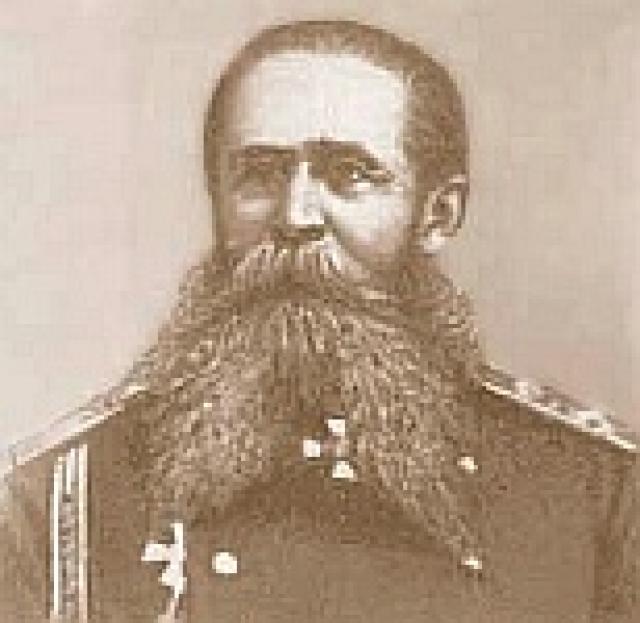
Iosif Gurko
 Russia
- Early Life and Military Career
- Military Exploits in the Russo-Turkish War of 1877-78
- Contributions to the Liberation of Bulgaria
- Post-War Appointments
- Military Reforms and Legacy
- Retirement and Death
Early Life and Military Career
Iosif Vladimirovich Gurko was born into a noble family and received a prestigious education at the Imperial Page Corps, graduating in 1848 as a cornet in the Leib-Guard Hussar Regiment. He quickly distinguished himself as a promising cavalry officer.
Military Exploits in the Russo-Turkish War of 1877-78
Prior to the outbreak of the Russo-Turkish War of 1877-78, Gurko commanded the 2nd Guards Cavalry Division. He played a pivotal role in the campaign, leading a vanguard of about 4,000 troops that audaciously seized key passes through the Balkan Mountains. He emerged victorious in several battles against the Ottoman forces, capturing Kazanlak and Shipka Pass.
Contributions to the Liberation of Bulgaria
During the siege of Plevna, Gurko's Western Detachment proved decisive in defeating the Turks at Gornji Dubnik and Telish. He subsequently launched a series of campaigns that culminated in the capture of Entropol and Orhaniye. With the fall of Plevna, Gurko's reinforced detachment succeeded in crossing the Balkan Mountains, seizing Philippopolis, and occupying Adrianople. This advance opened the path to Constantinople.
Post-War Appointments
After the war, Gurko was promoted to Commander-in-Chief of the Guards and the St. Petersburg Military District. He also held the positions of Temporary Governor-General of St. Petersburg (1879-1880), Temporary Governor-General of Odessa (1880-1883), and Warsaw Governor-General and Commander of the Warsaw Military District (1883-1894).
Military Reforms and Legacy
Under Gurko's leadership as Warsaw Governor-General, significant fortifications were constructed at Ivanogorod, Novogeorgievsk, Brest-Litovsk, and Warsaw, creating the Warsaw Fortified Region. He also oversaw the development of new roads and infrastructure in the region. As a member of the State Council (1884-1894), he actively contributed to government affairs.
Retirement and Death
Gurko retired from military service in 1894, having dedicated four decades to the Russian Army. He passed away on January 15, 1901, leaving behind a legacy of bravery, military acumen, and contributions to the Russian Empire.