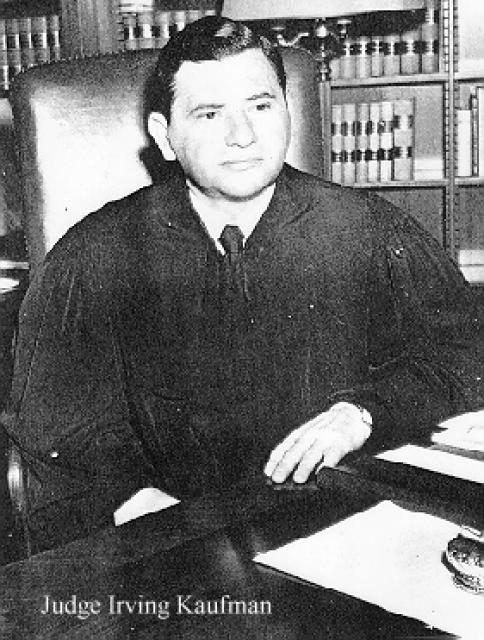
Irving Robert Kaufman
 USA
USABiography of Irvin Robert Kaufman
Irvin Robert Kaufman was an American federal judge and lawyer. He was born on June 24, 1910, in Brooklyn, New York, into a Jewish family. Kaufman graduated from Fordham Law School in 1931 and spent twenty years practicing law in New York City. During this time, he worked primarily in private practice but also served as an assistant federal attorney.
In 1949, Kaufman was appointed as a judge in the United States District Court for the Southern District of New York by President Harry S Truman. He served in this position until 1961 when President John F. Kennedy facilitated his appointment to the United States Court of Appeals for the Second Circuit. From 1961 to 1987, Kaufman served as a judge in the Second Circuit, including a tenure as Chief Judge from 1973 to 1980.
In 1987, Kaufman partially retired but continued to participate in the hearing of some cases until his death in 1992. On October 7, 1987, he was awarded the Presidential Medal of Freedom, one of the highest civilian honors in the United States, by President Ronald Reagan.
Kaufman was known for presiding over the trial of Julius and Ethel Rosenberg, American communists accused of espionage for the Soviet Union and transmitting secret nuclear-related information. Although Roy Cohn, one of the prosecutors in the case, claimed that Kaufman was appointed to the trial due to his influence and that Kaufman demanded the death penalty, there is no documentary evidence to support these allegations.
Throughout his career, Kaufman hoped to be remembered for his efforts in desegregating schools in the American North and his innovative approach to antitrust legislation. He also presided over hearings regarding the deportation of musician John Lennon from the United States to England based on Lennon's admission of possessing cannabis in England. Kaufman determined that Lennon's deportation was politically motivated and allowed him to remain in the United States, a decision that garnered criticism from some observers.
Today, a significant collection of Kaufman's personal and legal documents is housed in the Library of Congress in Washington, D.C., although it is not yet fully open to public access. Kaufman often expressed frustration with the way the press distorted judicial decisions, acknowledging that judges must communicate with the public through media outlets reporting on court rulings, which often resulted in inaccurate and superficial representations of their work.