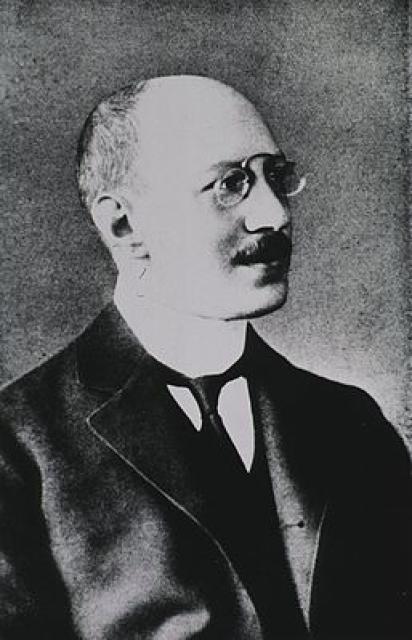
Iwan Bloch
 Germany
Iwan Bloch was a German dermatologist whose work helped establish the study of human sexuality as a subject spanning medicine, history, psychology, and culture. Writing at a time when sexual life was usually treated as a narrow medical or moral question, he argued for a broader field of inquiry. His research and publishing helped shape early sexology, even as many of his own conclusions reflected the assumptions and limits of his era.
Medical training and practice
Bloch was born on 8 April 1872 in Delmenhorst, in the Grand Duchy of Oldenburg. He studied medicine in Bonn, Heidelberg, and Berlin, receiving his medical license and doctorate in Würzburg in 1896. He specialized in dermatology and venereal diseases, first working in Berlin hospitals before establishing a private practice in Charlottenburg, then a suburb of Berlin.
Alongside clinical practice, Bloch taught at the adult education school in Berlin-Lichtenberg and wrote for both medical specialists and general readers. His clinical background shaped his interest in sexuality, but he resisted treating the subject only as a matter of diagnosis. He drew on historical records and cultural comparisons to place sexual behavior within social life and human history.
A new field of study
Bloch is often described as a founder of sexology, the interdisciplinary study of sexuality. His influential book “The Sexual Life of Our Time in Its Relations to Modern Civilization” appeared in 1907 and offered a wide-ranging survey of contemporary knowledge. Rather than confining the subject to medicine, he brought together material from history, anthropology, ethnology, and social observation.
He continued this work with publications on prostitution, sexual behavior, and the history of medicine. His 1908 “The Practice of Skin Diseases” reflected his medical specialty, while “The Prostitution” (1912) brought together research on a social subject he considered central to public health and society. He also contributed to the multivolume “Handbook of the History of Medicine.” In 1913, he helped found a medical society devoted to sexology, and the following year he was involved in launching a journal for the field.
Bloch also wrote historical studies under the pseudonym Eugen Dühren, including works on the Marquis de Sade and sexual life in England. His research helped bring newly discovered material by de Sade to scholarly attention, and he became known for building a large private library of medical and historical works.
Influence and limits
Bloch’s lasting contribution was his insistence that sexuality could be studied through several disciplines together. That approach helped give sexology an independent identity and influenced the wider conversation among early researchers. Yet his writing was not free from the moral judgments of his time. Some of his positions were conservative, and his ideas about sexual behavior are not accepted as modern scientific conclusions.
His theory that syphilis originated in the Americas was also disputed, and subsequent scholarship has treated the issue as far more complex than the argument he advanced. These limits are part of the historical record: Bloch was a pioneer in defining a field, but his own interpretations belonged to a period whose knowledge and social attitudes have since changed.
Legacy
Bloch died in Berlin on 19 November 1922, aged 50. He left a body of work that combined clinical medicine with broad historical and cultural research. Remembered as one of the formative figures in early sexology, he helped create a framework for studying sexuality as a subject with medical, social, and historical dimensions. His career also shows the tension that often accompanies pioneering scholarship: the field he helped establish outgrew many of the beliefs he brought to it.