Jack Ruby
- Early Life and Work
- Dallas Nightclubs
- The Shooting of Lee Harvey Oswald
- Trial and Appeal
- Final Months and Legacy
Jack Ruby became one of the most recognizable figures in the aftermath of President John F. Kennedy’s assassination, when he shot Lee Harvey Oswald in a Dallas police station as cameras recorded the transfer. Before that moment, he was a restless nightclub operator whose life had moved through Chicago street work, wartime service, and a string of small businesses. His motive remains a subject of debate, but his trial and the investigations that followed established a clear boundary between documented evidence and the many theories that grew around the case.
Early Life and Work
Ruby was born Jacob Rubenstein in Chicago in 1911 to Polish immigrant parents. The exact day is uncertain: school and government records gave conflicting dates, and he most often used March 25. His parents separated when he was a child, and he spent time in a foster home. He left school in his teens and worked a variety of jobs, including selling refreshments and tickets around sporting events. He also became involved in street life and frequent fights.
During World War II, Ruby served in the U.S. Army Air Forces as an aircraft mechanic, received a good-conduct medal, and was discharged in 1946. Afterward, he worked with his brothers in a small novelty-goods business. In 1947, he moved to Dallas and joined his sister Eva Grant in the nightclub business. Around the same time, he and his brothers adopted the surname Ruby, which he used for the rest of his life.
Dallas Nightclubs
Over the next sixteen years, Ruby operated a succession of clubs and pursued other ventures, from selling merchandise to managing entertainment venues. His businesses were often financially unsuccessful, and he was arrested several times, though Texas historians report that no serious charges were filed before the Oswald shooting. By 1963, he ran the Carousel Club, a downtown Dallas nightclub featuring performers and late-night acts. He was known for a quick temper and an intense desire to be noticed, traits that later colored press coverage of his actions.
The Shooting of Lee Harvey Oswald
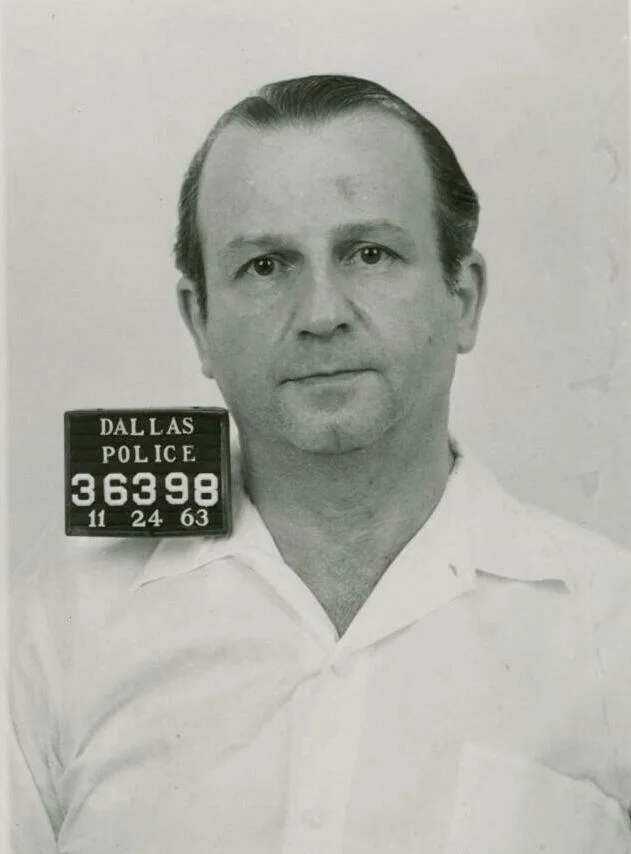
On November 22, 1963, Kennedy was assassinated in Dallas. Police arrested Oswald and held him at Dallas Police Headquarters. Two days later, as officers moved Oswald through the basement toward a transfer vehicle, Ruby stepped out from a crowd of reporters and police and shot him at close range. Oswald died at Parkland Memorial Hospital later that day. The shooting was captured live on television and watched by millions.
Ruby said he had acted out of grief and anger over Kennedy’s death and wanted to spare the president’s widow the ordeal of a trial. His account was not independently verifiable, and the motive has remained controversial. The Warren Commission examined the shooting and reported that it had found no evidence that Ruby acted with another person or that he had known Oswald. Public suspicion persisted in part because the killing silenced the accused assassin before he could stand trial, and because so many details of the Kennedy assassination itself remained contested.
Trial and Appeal
Ruby was indicted for Oswald’s murder and tried in Dallas in 1964. His lawyer, Melvin Belli, argued that Ruby had suffered an episode of psychomotor epilepsy and was not legally responsible for the shooting. The jury convicted him of murder with malice and sentenced him to death on March 14, 1964.
In October 1966, the Texas Court of Criminal Appeals overturned the conviction and ordered a new trial. The court found errors in the admission of testimony and held that Ruby’s case should have been moved out of Dallas, where intense publicity had made a fair trial difficult. A retrial was being arranged for Wichita Falls when Ruby’s health sharply declined.
Final Months and Legacy
Ruby was admitted to Parkland Hospital in December 1966, initially with what appeared to be pneumonia. Doctors diagnosed advanced lung cancer. He died on January 3, 1967, before a new trial could begin, and was buried in Chicago. He had never married.
Ruby’s act fixed his name in the national memory, but the surviving record offers no settled explanation for why he chose to shoot Oswald. Investigators documented the circumstances, the trial, and the appeal; Ruby himself insisted that grief and rage had driven him. The gap between those facts and the unanswered questions has kept his brief, shocking role in the Kennedy assassination story under scrutiny for decades.