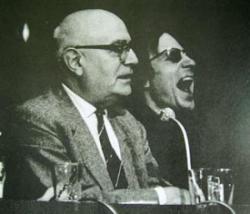
Jacques Derrida
 France
- Jacques Derrida: A Philosophical Titan
- Deconstructivism: A Revolutionary Perspective
- Key Works and Influences
- International Recognition and Activism
- Legacy and Impact
Jacques Derrida: A Philosophical Titan
Early Life and EducationJacques Derrida was born in El-Biar, Algeria, on July 15, 1930. As a young man, he served as a soldier in the Algerian War from 1957 to 1959. Subsequently, he pursued his philosophical studies at the École Normale Supérieure and later taught at the Sorbonne, the École Polytechnique, and other prestigious institutions.
Deconstructivism: A Revolutionary Perspective
Derrida's philosophical magnum opus, known as deconstruction, revolutionized the way we understand language, meaning, and truth. He challenged Western philosophy's traditional reliance on binary oppositions, arguing that meanings are not fixed but constantly shifting and unstable. Through his rigorous examination of language and its relationship to reality, Derrida sought to deconstruct the foundational concepts upon which Western metaphysics had rested.
Key Works and Influences
Derrida's prolific output included over 40 books and numerous articles. In works such as "Speech and Phenomena" (1967) and "Of Grammatology" (1967), he explored the primacy of writing over the spoken word, asserting that textual representations invariably shape our perceptions of reality. Derrida's ideas were influenced by diverse thinkers such as Hegel, Nietzsche, Husserl, Freud, and Heidegger.
International Recognition and Activism
Derrida's work gained international acclaim and sparked lively debates in academia and beyond. He was a vocal advocate for human rights and social justice, actively engaging in campaigns against apartheid in South Africa and repression in Czechoslovakia. He established the "International College of Philosophy" in 1983 to foster interdisciplinary intellectual exchange.
Legacy and Impact
Jacques Derrida passed away in Paris in 2004 at the age of 74, leaving behind an enduring philosophical legacy. His ideas continue to challenge our assumptions about language, knowledge, and reality, inspiring countless scholars and shaping the intellectual landscape of the 21st century. Despite criticisms for his perceived blurring of distinctions between reality and literature, Derrida's work remains a testament to the power of intellectual inquiry and the human pursuit of understanding.