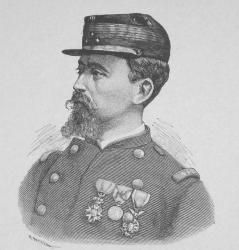
Jacques-Joachim Shetardi
 France
Biography of Jacques-Joachim Trotti, Marquis de la Chétardie
Jacques-Joachim Trotti, Marquis de la Chétardie (1705-1758) was a French diplomat and general. He began his military career as a lieutenant in the royal regiment and served until the end of his life. During his service, he fulfilled several diplomatic missions, including being sent to London in 1727, followed by assignments in the Netherlands, Prussia, Russia (twice), and Turin in 1742.
In 1739, Chétardie was appointed as an ambassador to St. Petersburg, where he found German dominance and hostility towards France. Wanting to weaken the German faction, he began plotting against Duke Biron, an enemy of the French. However, Biron was overthrown by Minich, another opponent of France, as well as by Anna Leopoldovna, the ruling empress at the time.
Russia was a mystery to the French at that time, and Chétardie sought to establish Empress Elizabeth Petrovna on the throne. By removing the Germans, who were hostile to France, he hoped to make Russia's policies more favorable to France. Additionally, Elizabeth had sympathies towards Louis XV and all things French. However, he also wanted to weaken Russia by delaying its progress. He believed that once Elizabeth Petrovna came to power, the court would move to Moscow, and the reforms of Peter the Great would be forgotten. He thought that Russia's interference in European affairs would decrease, benefitting France's allies - Sweden, Poland, and Turkey.
Chétardie and other French diplomats were mistaken in their assumptions. However, he managed to gain the favor of Empress Elizabeth Petrovna and influenced her through her doctor, Lestocq. While instigating her against the ruler Anna Leopoldovna, he also acted as a mediator between Elizabeth and the Swedes, whom the French urged to declare war on Russia under the pretense of reclaiming territory taken by Peter the Great. The coup of 1741 took place without Chétardie's direct involvement, but he was graciously thanked by Empress Elizabeth and awarded the Order of St. Andrew.
The war with Sweden turned out to be successful for the Russians. In an attempt to achieve two goals at once, Chétardie arranged a truce between the warring parties. However, the Swedes resumed the war to their own detriment within a month. In September 1742, Chétardie was recalled to France and left Russia with numerous gifts from the empress.
In 1743, at the request of Empress Elizabeth, Chétardie was once again appointed as an ambassador to Russia. However, during his journey, he carried out diplomatic missions in Copenhagen and Stockholm. By that time, the Russian court had leaned towards an alliance with Austria and England, led by Chancellor A.P. Bestuzhev. Chétardie attempted to overthrow Bestuzhev, collaborating with the former princess of Anhalt-Zerbst (Catherine the Great), the Prussian envoy, and Dr. Lestocq. Bestuzhev intercepted a French courier carrying sensitive documents, deciphered them, and exposed the conspiracy to the empress. As a result, Chétardie was expelled from Russia on June 17, 1744. This severe measure was partly due to Chétardie's overzealous desire to influence the empress's decisions and play a significant role in her court, which became burdensome and generated a strong desire to be rid of such an intrusive friend. Other participants in the conspiracy were also punished through expulsion or exile.
After his failure, Chétardie fell out of favor at the French court. He was imprisoned in the Citadel of Montpellier but was soon pardoned and appointed to the active army in Italy. In 1749, he became an envoy to the court of Turin but returned to the army with the start of the Seven Years' War. He fought at the Battle of Rossbach and was appointed as the commander of the city of Hanau.
Chétardie was a typical French aristocrat of his time. Gifted with a quick mind but self-assured and prone to impulsive actions, he was willing to sacrifice everything to shine and play a role. He could give lessons in high etiquette and refinement to foreigners, but his politics often resembled salon intrigues.
During his time in Europe, Chétardie published a provocative document titled "The Testament of Peter the Great," which was brought in his diplomatic baggage from Russia. He was even mentioned as one of its possible authors.