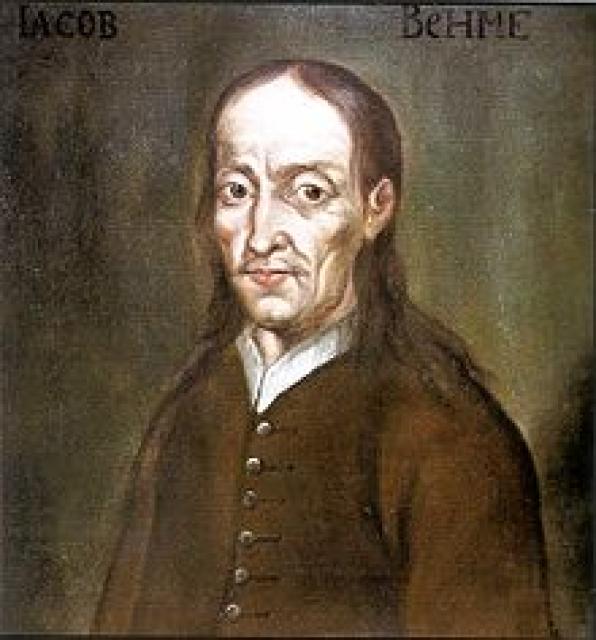
Jakob Boehme
 Germany
- Biography of Jakob Böhme
- Mystical Revelation and Spiritual Development
- Works and Themes
- Worldview
- Jakob Böhme passed away in Görlitz on November 17, 1624.
Biography of Jakob Böhme
Jakob Böhme, often referred to as the "philosopher of the Germans" (Philosophus Teutonicus), was a German mystic and philosophical theologian. He was born on April 24, 1575 in Alt-Seidenberg, a village near Görlitz in Saxony. Böhme was raised in the Lutheran faith and received only a basic education. He worked as an apprentice and later became a journeyman to a cobbler in Seidenberg. In 1599, he opened his own shoemaking workshop in Görlitz.
Mystical Revelation and Spiritual Development
In 1600, seemingly influenced by the local pastor Martin Moller, Böhme experienced a profound mystical revelation in which he realized that all existence is based on the principles of "Yes" and "No." As Böhme matured spiritually, his mystical experiences deepened, and he eventually expressed his insights in a series of remarkable theological and philosophical writings. His first book, "Aurora, or the Rising Dawn" (Aurora, Morgenröte im Aufgang, 1612), which he called his "infantile beginning," attracted widespread attention but also led to a ban on Böhme's writing by the city council of Görlitz.
Böhme remained silent for seven years but eventually resumed his literary activities at the urging of a small circle of friends and admirers who were acquainted with his works. From 1619 until his death, Böhme wrote 30 books and treatises, some of which were left unfinished. These works established him as one of the greatest speculative philosophers of the West and had a significant influence on F. Schelling, G.W.F. Hegel, A. Schopenhauer, F. Nietzsche, E. von Hartmann, H. Bergson, M. Heidegger, and P. Tillich.
Works and Themes
Böhme's writings can be divided into several groups. His philosophical works include treatises on the three principles (Von den drei Principien, 1619), the triple life of man (Von dem dreifaltigen Leben des Menschen, 1619), forty questions about the soul (1620), the incarnation (Von der Menschwerdung Christi, 1620), the impress of all beings (1622), as well as two mature works: On the Election by Grace (Von der Gnadenwahl, 1623) and The Great Mystery (Mysterium magnum, 1623).
His mystical and religious writings, usually published under the collective title "The Way to Christ" (Der Weg zu Christo), include True Repentance (1622), On Regeneration (1622), On Supersensual Life (1622), and On Divine Prayer (1624). Böhme also wrote apologetic treatises, some of which were directed against radical sectarians such as Schütz and Metz, one against the alleged crypto-Calvinist Balthasar Tilke, and one against the persecution by the pastor Gregor Richter of Görlitz.
Worldview
Böhme's worldview is characterized by the introspective nature of German mysticism and a Renaissance-inspired natural philosophy. He sought to understand how this contradictory world, rooted in God, whom Böhme describes as the "abyss (Ungrund) and foundation (Grund) of all existence," arose from the "Yes" and "No" of the "dark will of wrath" and the "fiery will of love."


