Jan Blaeu
 Netherlands
- Early Life and Education
- Career and Atlas Publications
- Expansion and Recognition
- Atlas Maior and Legacy
- Death and Legacy
Early Life and Education
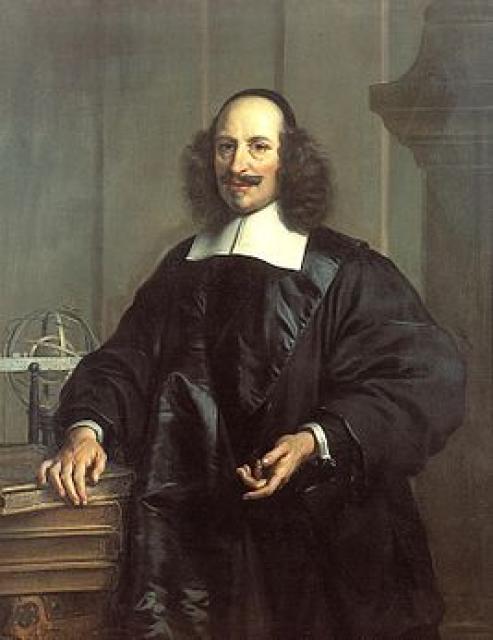
Joan Blaeu, a renowned Dutch cartographer and publisher, was born in 1596 to Willem Blaeu and Maria van Uitgeest. In 1603, his family relocated to Amsterdam, where his father established a globe and map-making firm.
Little is known about Joan Blaeu's early life. He enrolled at the University of Leiden in 1620, obtaining a doctorate in law. Subsequently, he studied at the University of Padua in 1623.
Career and Atlas Publications
Blaeu's involvement in his father's business is suggested by his inclusion in the 1631 publication "Atlantis Appendix." In 1636, he published the first edition of "Novus Atlas" (Theatrum orbis terrarum, sive, Atlas novus). This seminal work solidified Blaeu's reputation as a cartographer.
After his father's death in 1638, Joan inherited the family business with his brother Cornelius. He also became the official cartographer for the Dutch East India Company. In 1640, he released three additional volumes of "Atlas novus."
Expansion and Recognition
In 1650, Blaeu became the sole owner of his father's company after his brother's passing. He was elected to Amsterdam's city council in 1651 and later became a magistrate. Two more volumes of "Atlas novus" were published in 1645 and 1654.
Blaeu's atlas showcased meticulous maps of English counties and Scotland, as well as a volume dedicated to East Asia. Around 1652, he published a two-volume atlas of Dutch cities, including those in both the Republic of the United Netherlands and the Spanish Netherlands.
Atlas Maior and Legacy
Blaeu's most ambitious project was the "Atlas Maior," a massive 11-volume work published in 1662. With over 600 maps and 3000 pages of Latin text, it aimed to serve as a comprehensive guide to geography.
The atlas was printed on high-quality paper and adorned with intricate embellishments. Priced at a premium, it symbolized the wealth of its owner. Blaeu's atlas was translated into French, Dutch, and German, and one French edition is currently housed in Russia.
Death and Legacy
Plans for a Spanish edition of the atlas were never realized. A devastating fire in Amsterdam on February 23, 1672, destroyed Blaeu's workshop, along with numerous printing presses, books, and papers. Blaeu's passing the following year is commonly attributed to the impact of the fire on his health. He was buried in the Westerkerk in Amsterdam. His company continued operating until 1698.