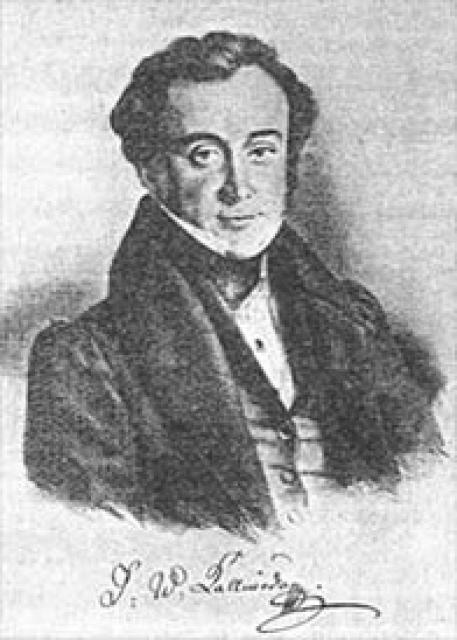
Jan Vaclav Kalivoda
 Czech
CzechEarly Life and Education
Johann Wenzel Kalliwoda was born on February 21, 1801, in Prague, Bohemia (present-day Czech Republic). From an early age, he displayed an exceptional musical talent, and in 1815, he became one of the first graduates of the Prague Conservatory. There, he studied violin under Friedrich Wilhelm Pixis.
Orchestral Career
After graduating from the conservatory, Kalliwoda embarked on an orchestral career. From 1816 to 1821, he played violin in the orchestra of the Prague Theater. His virtuosic abilities quickly gained recognition.
Court Composer
In 1822, Kalliwoda was appointed court composer to the Fürstenberg princes. He resided primarily at their estate in Donaueschingen, where he remained until the revolution of 1848.
Compositions
Throughout his career, Kalliwoda composed a prolific body of works, totaling approximately 450 pieces. His output included six symphonies, seven concertos for violin and orchestra, three string quartets, and numerous violin and piano pieces. Notably, he also composed the opera "Blanda" in 1847.
Musical Legacy
Kalliwoda's music has been praised for its lyrical beauty and melodic charm. American musicologist David Hurwitz has described it as "something of a missing link between the symphonism of Beethoven and Schumann." Kalliwoda was highly respected by his contemporaries. Robert Schumann dedicated his Six Intermezzi for Piano (1832) to Kalliwoda. Additionally, his New Overture was included in the program of the very first concert of the New York Philharmonic Orchestra on December 7, 1842, alongside works by Mozart, Beethoven, Weber, and Hummel.
Later Years
Following the revolution of 1848, Kalliwoda returned to Prague, where he continued to compose and teach until his death on December 8, 1866. He left behind a substantial musical legacy that continues to be enjoyed and appreciated today.


