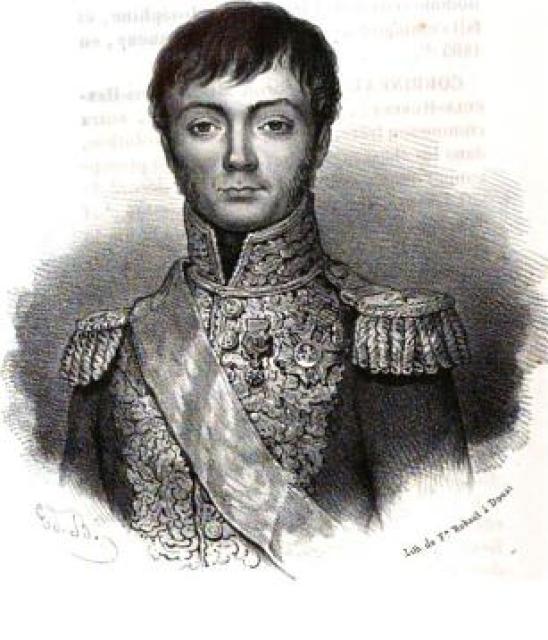
Jean-Baptiste Juvenal Corbineau
 France
- Early Life and Military Career
- Napoleonic Campaigns
- Russian Campaign and the Crossing of the Berezina
- Campaign of 1813 and Battle of Waterloo
- Retirement and Legacy
Early Life and Military Career
Louis-Pierre de Montbrunwas born into a family of horse breeders. At the tender age of 16, he joined the military, enrolling in the 18th Cavalry Regiment on October 3, 1792. He fought valiantly with the Northern Army before transferring to the 5th Hussar Regiment on March 1, 1795.
Napoleonic Campaigns
In 1801, Montbrun became a lieutenant with the 5th Horse-Jaeger Regiment, commanded by his elder brother, Constantin. He rose swiftly through the ranks, becoming a squadron commander in the Hanoverian Legion on February 2, 1804, and a major in the 10th Hussar Regiment on May 16, 1806.
Montbrun fought in the 1806-1807 campaign in East Prussia, distinguishing himself at the battles of Eylau, Heilsberg, and Friedland. His efforts earned him the rank of colonel on January 7, 1807, and the command of the 20th Dragoon Regiment.
In 1808, Montbrun was transferred to the Peninsular War in Spain, where he played a crucial role in capturing Burgos and the Battle of Ocaña. Promoted to brigadier general on August 6, 1811, he was appointed governor of Granada.
Russian Campaign and the Crossing of the Berezina
Montbrun's rise continued as he commanded the 6th Cavalry Brigade under Saint-Cyr in early 1812. During the invasion of Russia, he led all light cavalry under Oudinot's command. At the Battle of Polotsk, he faced a desperate situation when Cossacks cut him off from the army. With remarkable courage and skill, he navigated the 3rd Russian Army and rejoined his forces.
Later, he was tasked with scouting a crossing point over the Berezina River. His timely discovery of the village of Studenka proved crucial for Napoleon's army, enabling them to cross the river and avoid disaster. Napoleon rewarded him by appointing him general adjutant.
Campaign of 1813 and Battle of Waterloo
In 1813, Montbrun served as a cavalry division commander under Victor. At the Battle of Dresden, his contribution helped secure a French victory. At the Battle of Kulm, he led a cavalry charge against the Prussian corps under Kleist, breaking through their formation and delivering the news of Vandamme's defeat to Napoleon. His bravery earned him a promotion to divisional general.
After the Battle of Montmirail, Montbrun defended Reims against Saint-Priest's forces, earning him the Commander's Cross of the Legion of Honour. Upon Napoleon's return from exile, Montbrun once again rallied to his cause, fighting at the Battle of Waterloo.
Retirement and Legacy
Following Napoleon's final defeat, Montbrun remained without a post until 1830. He was prohibited from wearing military uniform. However, after the 1830 revolution, he was appointed commander of the 16th Division, a position he held until 1846. In 1838, he was named a peer of France.
Montbrun died in Paris on December 18, 1848. His name was later inscribed on the Arc de Triomphe, and a bust of him was erected in Versailles. His brother, Claude, also served as an aide-de-camp to Napoleon, tragically killed in action at the Battle of Preussisch-Eylau.