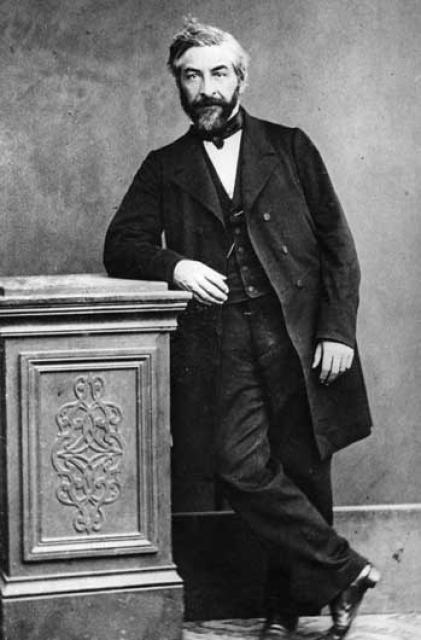
Jean Charles Galissard de Marignac
 Switzerland
- Jean Charles Galissard de Marignac
- Academic Career
- Scientific Contributions
- Atomic Masses:
- Niobium and Tantalum Separation:
- Discovery of Ytterbium and Gadolinium:
- Scientific Controversy
- Legacy
Jean Charles Galissard de Marignac
Early Life and EducationJean Charles Galissard de Marignac was a Swiss chemist born in Geneva on April 24, 1817. He showed an early interest in science and pursued his education at the École Polytechnique Fédérale de Zurich. In 1839, he graduated from the École Supérieure des Mines in Paris.
Academic Career
After graduating, Marignac returned to Geneva and became a professor at the University of Geneva in 1841. He remained at the university for the rest of his career, teaching chemistry and conducting research. In 1866, he was elected a corresponding member of the Paris Academy of Sciences.
Scientific Contributions
Marignac's scientific contributions focused on inorganic chemistry, particularly the study of rare earth elements.
Atomic Masses:
Between 1842 and 1883, Marignac determined the atomic masses of 29 elements using the approach proposed by Prout.
Niobium and Tantalum Separation:
In 1866, Marignac developed a method to separate niobium and tantalum, two chemically similar elements.
Discovery of Ytterbium and Gadolinium:
In 1878, Marignac discovered ytterbium oxide. Two years later, in 1880, he discovered an oxide of an unknown rare earth element that was later named gadolinium oxide in 1886.
Scientific Controversy
Marignac became involved in a heated scientific controversy with Saxon chemist Joseph Rudolph Hermann in 1866-1877. Marignac denied the existence of ilmenium, an element claimed to have been discovered by Hermann. The disputed element was later identified as technetium.
Legacy
Jean Charles Galissard de Marignac was a renowned chemist who made significant contributions to the understanding of rare earth elements. His discoveries and methods laid the foundation for further research in this field. He passed away in Geneva on April 15, 1894.


