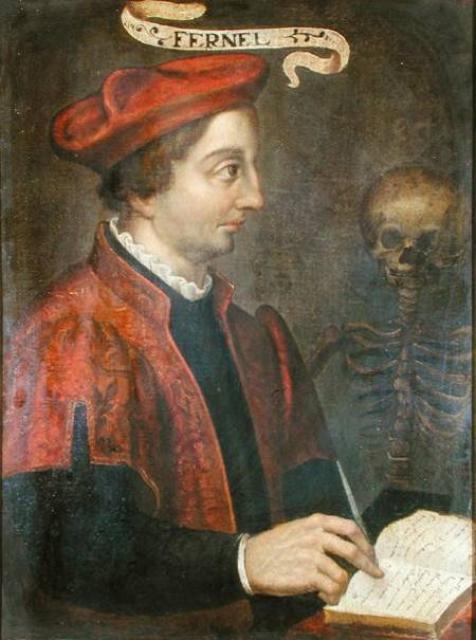
Jean Fernel
 France
Biography of Jean Fernel
Jean Fernel was a French scientist and physician who made significant contributions to the field of medicine during the Renaissance period. He was born in Amiens, France, and later studied at the College of Sainte-Barbe in Paris, where he was educated in various subjects including mathematics, geodesy, and astronomy. It was only later that Fernel decided to pursue a career in medicine.
In 1524, Fernel enrolled at the University of Paris and obtained his medical degree in 1530. During this time, it was common for scholars to study multiple disciplines, and Fernel's diverse scientific interests were characteristic of the era. However, he ultimately chose medicine and quickly gained recognition as a remarkable physician.
Fernel became renowned for his exceptional skills and earned a reputation as a miraculous doctor. He was invited to serve as a court physician to King Henri II and Catherine de Medici. It is believed that he cured Catherine de Medici of infertility, after which he was bestowed the title of "Europe's First Physician."
Although Fernel initially published works on mathematics and astrology, he later focused on medical subjects. He authored treatises on physiology, bloodletting, and the causes of diseases. In 1542, he published his notable book "De naturali parte medicinae" ("The Natural Part of Medicine"), which explored human physiology and established the terms "physiology" and "pathology." Fernel's book "Physiologia" remained the sole textbook and reference guide on the subject for over a century.
Fernel's most significant work, "Universa Medicina" ("Universal Medicine"), was published in 1554. This treatise encompassed physiology and pathology and was reprinted over 30 times, with the final edition released more than a century after his death.
Jean Fernel passed away in 1558, and his contributions to the field of medicine were recognized posthumously. His name remains in the annals of medical history, forever remembered for his groundbreaking work and influence on the development of medicine.




