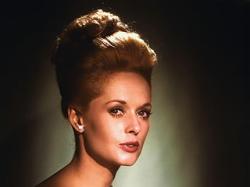
Jeanne Moreau
 France
Biography of Jeanne Moreau
Jeanne Moreau, the French actress, gained as much fame as her fellow countrywomen Brigitte Bardot and Catherine Deneuve. While Bardot and Deneuve were considered the epitome of beauty, with a single glance at them causing men's hearts to skip a beat, Moreau possessed a different kind of beauty – an intellectual beauty. It was thanks to her memorable appearance and exceptional acting talent that Moreau was etched into the history of world cinema as one of the greatest actresses in France's history.

Early Life and Education
Jeanne Moreau was born on January 23, 1928, in Paris, into the family of Anatole-Désiré Moreau, the manager of a brewery, and Catherine Moreau, a dancer. Her father was French and her mother was English, hailing from Lancashire. Moreau never particularly enjoyed school, and her interest in education waned completely at the age of 16 after watching a theatrical production of Jean Anouilh's "Antigone". Driven by a desire to pursue a creative career, she enrolled in the Paris Conservatory of Music and Dance.

During her time at the conservatory, Moreau's parents divorced, and her mother moved back to England with her younger sister Michelle. Moreau made her debut in the theater in 1947, at the age of 19, performing at the Avignon Theater Festival. This led to her joining the famous Comédie-Française theater company. As the youngest actress in the company's history, Moreau's talent was so evident that, despite her young age, she became a key member of the troupe, appearing in almost all productions. Her debut performance at the Comédie-Française was in Ivan Turgenev's play "A Month in the Country".

Acting Career
In 1949, at the age of 21, Jeanne Moreau got married for the first time to French actor, screenwriter, and director Jean-Louis Richard. That same year, she made her film debut in "Last Love". Although her role in this film was not a leading one, Moreau continued to appear on the big screen, hoping to rise to the forefront. However, theater remained her primary focus, and she became an actress at the National People's Theater, where she excelled in productions such as Anna Bonacci's "The Dazzling Hour", Jean Cocteau's "The Infernal Machine", and Bernard Shaw's "Pygmalion".
Moreau finally left the theater in the mid-1950s to concentrate on film acting. From 1953 to 1957, she appeared in numerous films, including "Girls of the Night" (1953), "Julietta" (1953), "Don't Touch the Loot" (1954), "Gas-Oil" (1955), and "The Strange Mr. Steve" (1957). Then came a breakthrough in her film career – the twentieth film in her filmography, "Elevator to the Gallows" (1957). This crime drama directed by Louis Malle was a huge success, and Moreau, who had divorced her husband in 1951, began a romantic relationship with Malle. She also starred in his film "The Lovers" (1958), a controversial and daring drama that earned her the title of the "new Bardot" from the media. For her role in this film, Moreau won the Venice Film Festival award, her first accolade.
Throughout her career, Moreau had romantic relationships with various notable figures, including fashion designer Pierre Cardin, jazz trumpeter Miles Davis, and Greek actor Theodoros Roubanis. She married American film director William Friedkin in 1977, but the marriage ended in 1979. In 1964, she officially divorced Jean-Louis Richard, with whom she had a son named Jérôme.
Later Career and Legacy
Jeanne Moreau's career spanned several decades, and she received numerous awards for her contributions to cinema. Some of her notable accolades include prizes from the Cannes Film Festival (1960, 2003), the British Academy Film Awards (1967, 1996), the César Awards (1992, 1995, 2008), the Venice Film Festival (1992), the San Sebastián International Film Festival (1997), the Berlin International Film Festival (2000), and the Moscow International Film Festival (2005).
Moreau considers her best acting work to be in François Truffaut's "Jules and Jim". She also tried her hand at directing and screenwriting, with films such as "Lumière" (1976), "The Adolescent" (1979), and "Lilian Gish" (1983). Although she officially retired from acting after her role in the Portuguese director Manoel de Oliveira's drama "Gebo and the Shadow" (2012), she left a lasting impact on classic cinema.
Fans of classic cinema and devoted followers of Jeanne Moreau, whom director Orson Welles once called the "greatest actress in the world," can eagerly await new projects from her or revisit her extensive filmography, which continues to captivate audiences.